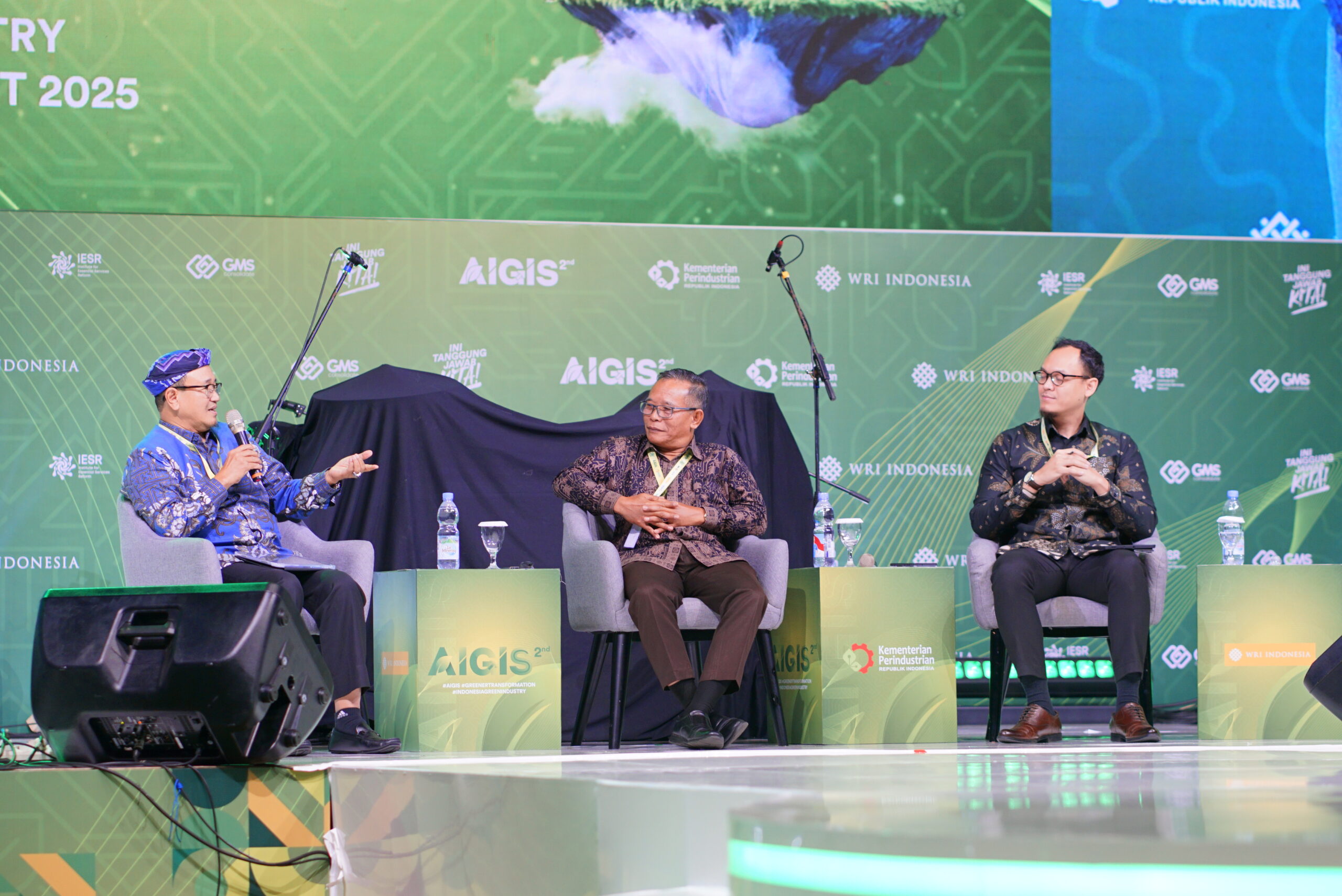
Jakarta, August 22, 2025 — The Annual Indonesia Green Industry Summit (AIGIS) 2025, organized by the Ministry of Industry at the Jakarta Convention Center (JCC), featured a session titled “Real Practices of Green Industry to Drive Replication and Sustainable Innovation.”
Moderated by Ahmad Shahran Adianto, Country Coordinator of ETP UNOPS, the panel brought together two speakers: Gadang Harto Hartawan (Vice Director, PT OKI Pulp and Paper Mills) and Komarudin Kudiya (Chairman, Indonesian Batik Artisans and Entrepreneurs Association/APPBI).
Energy Transition and Ecosystem Rehabilitation at OKI Pulp and Paper
Gadang Harto Hartawan highlighted how PT OKI Pulp and Paper Mills applies an integrated system from raw materials to logistics, while relying almost entirely on renewable energy. By utilizing black liquor and bark gasification technology, the company has reduced emissions by 4.2 million tons annually.
“Almost 100% of our energy comes from renewable sources derived from wood itself. The gasification technology we applied proves that large-scale industries can break free from fossil fuel dependency,” Gadang explained.
In addition, the company is committed to environmental rehabilitation.
“Since 2018, we have rehabilitated more than 450 hectares of mangrove forests. This effort has absorbed around 372 thousand tons of carbon while also creating new green areas that now serve as education and ecotourism sites,” he added.
Eco-Friendly Batik as a Pathway to Green Industry
Komarudin Kudiya addressed the challenges faced by over 130,000 batik artisans across Indonesia in meeting green industry standards. As a first step, APPBI has promoted the concept of eco-friendly batik.
“Not all small businesses can build full-scale wastewater treatment facilities. That’s why we start with good housekeeping — managing raw materials, minimizing waste, and changing production behavior from the ground up,” Komarudin said.
APPBI also introduced a simple wastewater treatment device called Alimba, now installed in 23 batik centers in Cirebon with support from corporate grants and financial institutions.
“The device is low-cost, easy to use, and follows the 3R principles — reduce, reuse, recycle. With around IDR 40,000, 1,000 liters of wastewater can be treated, and the water reused for production,” he explained.
Building a Green Culture and Overcoming Resistance
Both PT OKI and APPBI emphasized that success in green transformation is not only about technology but also about nurturing organizational culture. Gadang stated,
“The key lies in leadership by example. By practicing what we preach, we can instill a green culture among more than 3,200 employees, from daily campaigns to mandatory tree planting.”
At the same time, Komarudin acknowledged that artisans were initially resistant to the green industry concept, viewing it as too burdensome.
“When we introduced eco-friendly batik, supported by SOPs and training, artisans gradually realized its benefits. Now, more and more small batik enterprises are willing to transform,” he said.
Inspiration for Replication and Collaboration
Moderator Ahmad Shahran Adianto concluded the session by underlining that the real practices demonstrated by both the pulp & paper and batik sectors can serve as valuable models for other industries. He noted that these initiatives prove sustainable transformation is achievable through innovation, organizational culture, and cross-sector collaboration.