
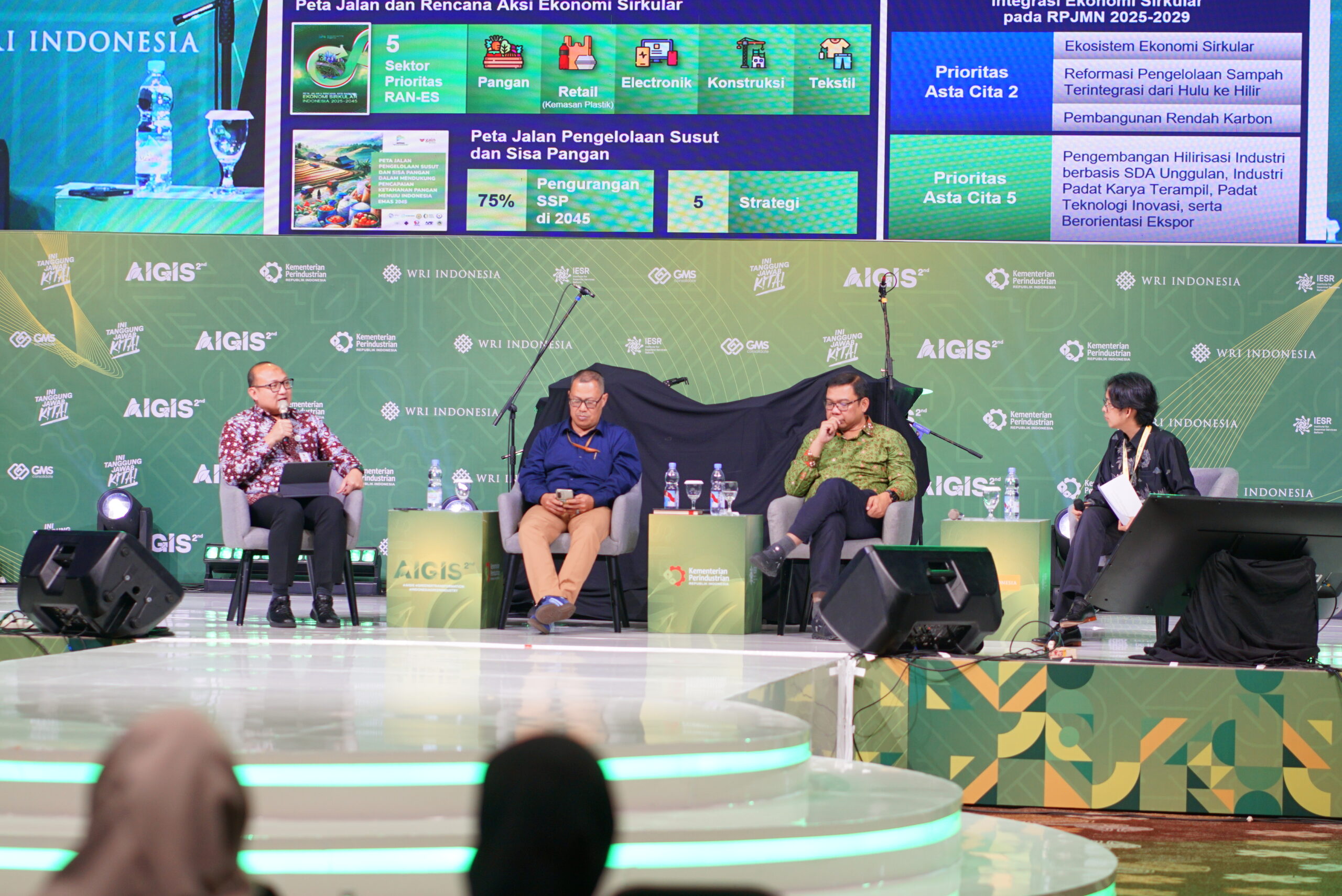

Jakarta, August 22, 2025 — The Annual Indonesia Green Industry Summit (AIGIS) 2025, organized by the Ministry of Industry at the Jakarta Convention Center (JCC), featured a panel discussion titled “Strengthening Circular Economy Practices through Integrated Policies.” The session explored how cross-sectoral policy integration can accelerate the adoption of circular economy in Indonesia as part of the green industry transition.
The discussion was moderated by Jonathan Davy, Co-Founder & CEO of Ecoxyztem, and brought together three key speakers: Apit Pria Nugraha (Head of the Green Industry Center, Ministry of Industry), Agus Rusly (Director of Waste Reduction and Circular Economy Development, Ministry of Environment), and Nizhar Marizi (Director of Environment, Ministry of National Development Planning/Bappenas).
Ministry of Industry: Mainstreaming the Circular Economy
Apit Pria Nugraha emphasized that the Ministry of Industry regards circular economy as a core strategy in building a green industrial ecosystem.
“Circular economy is not just an option but a necessity for making our industries more efficient, competitive, and globally resilient,” he stated.
He added that circular economy requires comprehensive, cross-policy integration.
“It cannot be only about technology or incentives, but must also be supported by regulations covering the entire value chain. GISCO is one of the instruments we are preparing to ensure its implementation,” Apit explained.
Ministry of Environment: Waste Management as the Foundation
From the perspective of the Ministry of Environment, Agus Rusly highlighted that waste management is central to realizing circularity.
“If we can reduce waste generation while channeling it back into the production chain, we are not only solving environmental problems but also creating new economic opportunities,” he noted.
He further underscored the importance of Extended Producer Responsibility (EPR) in strengthening producers’ role.
“Producers must take responsibility not only until the point of sale but also to ensure that their products return to the system. That is the essence of true circularity,” Agus added.
Bappenas: Aligning Vision with Long-Term Planning
Nizhar Marizi stressed the importance of embedding circular economy into Indonesia’s long-term development agenda.
“Circular economy must be integrated into national development planning, not treated as a separate project. At Bappenas, we are working to align green industry targets with broader sustainable development goals,” he explained.
He also highlighted the wider economic benefits of circular transformation.
“Circularity does not only reduce emissions and waste but also creates new jobs, technological innovations, and green investment opportunities,” Nizhar remarked.
Cross-Sectoral Synergy for a Green Transition
Moderator Jonathan Davy concluded by emphasizing that success in circular economy can only be achieved through strong collaboration between ministries, industry players, and communities.
Panel 9 demonstrated that circular economy is not merely a concept but a strategic direction for national development. With integrated policies, Indonesia has the opportunity to strengthen its competitiveness while ensuring environmental sustainability in the green transition era.