
Shraddha Thanawala, Remiges Apac Pte Ltd
Introduction
Over the past four decades, developing economies have followed an unexpected path to technological maturity. Rather than replicating the systems adopted by developed nations, they leapfrogged legacy infrastructure entirely—building cloud-native, API-driven systems from the ground up. Today, as Artificial Intelligence reshapes enterprise delivery, the question is no longer who adopts first, but who has the right foundations to adopt responsibly.
Let’s explore how a new class of “systems designers” filled a critical gap in the ecosystem, and why AI amplifies these advantages for organizations that combine modern infrastructure with disciplined human judgment.
The Three Eras of Tech in Developing Markets
Era 1: The MNC Tax (1980s–2000s)
In the early decades, large enterprises in developing markets had only two choices: expensive, rigid MNC products (SAP, Oracle, mainframes) or improvised, unsustainable solutions. Mid-market organizations typically chose the latter—assembling patchwork systems led by senior coders who, while talented, lacked architectural discipline. Design wasn’t a discipline; it was coding that happened to work. Spreadsheets filled gaps. Systems were fragile, expensive to maintain, and impossible to scale.
Era 2: The Rise of Systems Designers (2005–2020)
A transformation emerged. A generation of Indian, Vietnamese, and Philippine technologists didn’t just execute specs—they designed systems. Companies like Infosys, Wipro, TCS, and boutique delivery firms built a new layer: fractional access to world-class architects at a fraction of MNC prices. For the first time, mid-market enterprises could say: “We don’t need SAP. Here’s a modern, scalable system built for our business—and it costs 1/5th.” The “boutique technology” companies offered their skills to developing countries.
These “projects companies” offered what the ecosystem was missing: problem-solvers who understood architecture, not just coding.
Era 3: The Leapfrog Advantage (2010–Present)
While developed markets spent the 2010s modernizing legacy monoliths, developing markets were already building on cloud-native, API-first foundations. The result: enterprises in India, Vietnam, and similar markets now have better technical architectures than many developed market peers.
Consider the comparison:
| Function | Legacy Approach | Leapfrog Approach |
| Payments | ACH, SWIFT (1970s infrastructure) | UPI – real-time, API-based, billions of transactions annually |
| Core Banking | COBOL-based mainframes, rigid ERPs | Cloud-native platforms designed for scale |
| KYC / Identity | Manual verification, fragmented | Aadhaar-based eKYC, instant, unified |
| Talent Access | Expensive, scarce | Abundant, English-proficient, design-capable |
This wasn’t luck. Developing markets had to build differently because they couldn’t afford the MNC tax. That constraint became their competitive advantage.
The New Paradigm: AI as Disciplined Collaboration
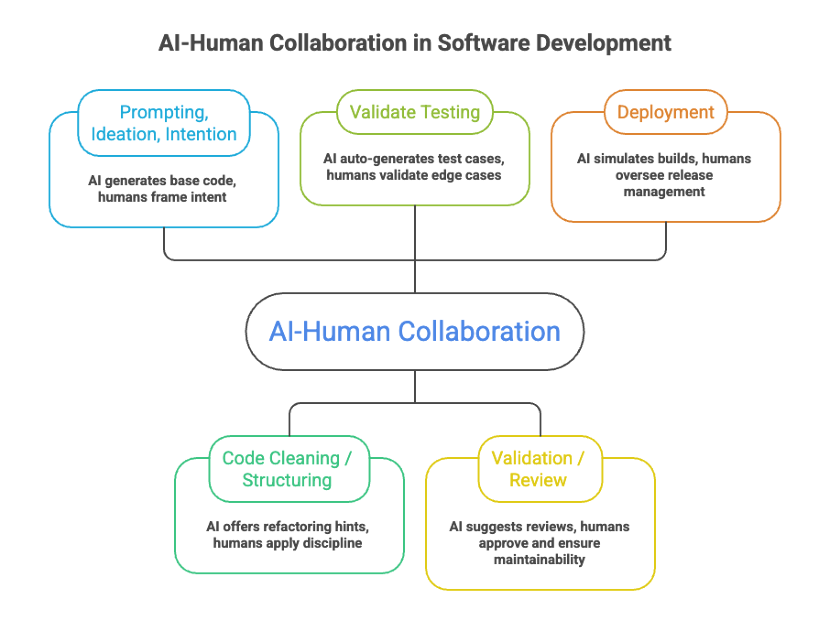
AI represents the next leap in productivity—but only when treated as a collaborative intelligence, not an automated solution. AI’s true value rests on two foundational pillars:
1. Human-in-the-loop: AI is a brilliant assistant, but not an autonomous agent. Its value depends entirely on the quality of human prompting, judgment, and validation at every stage. A developer who understands domain logic, business context, and architectural constraints will extract far more value from AI than one who treats it as a replacement for thinking.
This isn’t a limitation—it’s the design.
2. Guard rails: AI introduces new risks: generated code with unseen dependencies, probabilistic logic embedded in critical systems, corner cases and edge conditions poorly
handled by current LLMs. Without guardrails, AI-assisted delivery becomes a source of technical debt, not acceleration.
Guard rails are automated testing, code review gates, audit trails, and fallback mechanisms that ensure AI-generated code meets production standards.
Conclusion: The Thoughtful Integrators Win
The technology adoption paradox reveals a counterintuitive truth: being “late” to legacy systems was actually being early to modern architecture. Developing markets didn’t catch up to the West—they bypassed the dead-end and built the future infrastructure first.
Organizations with modern foundations, design-capable talent, and production discipline don’t just adopt AI faster—they adopt it better. They merge art (design thinking), science (rigorous validation), and intelligence (AI-augmented delivery) into sustainable outcomes.
The future belongs not to the fastest adopters of new tools, but to the most thoughtful integrators—those who understand that intelligence isn’t about machines replacing humans, but humans orchestrating machines with discipline and intention.
For developing markets, this is the moment to lead.