
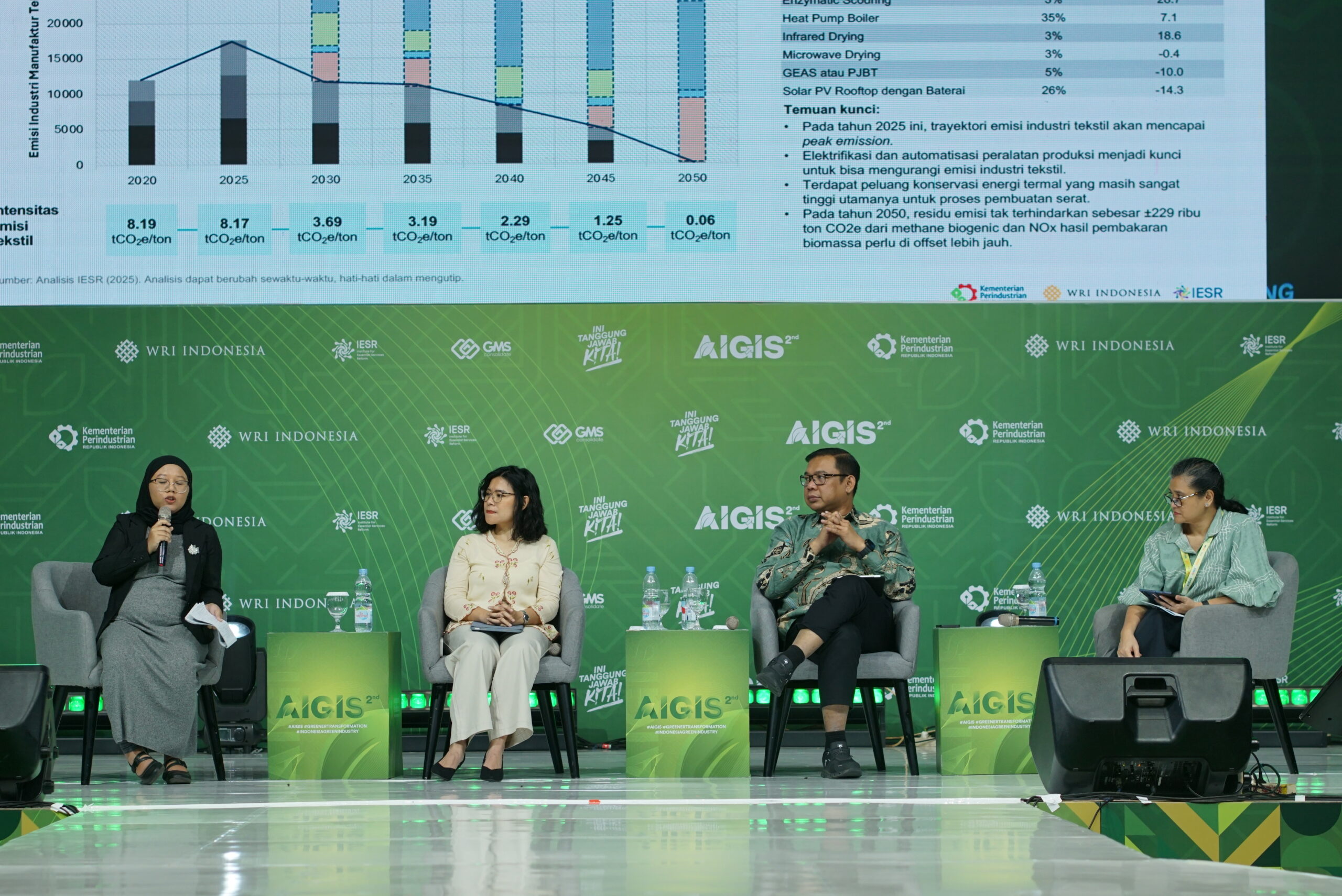

Jakarta, 22 August 2025 – The Annual Indonesia Green Industry Summit (AIGIS) 2025, organized by the Ministry of Industry, continued its series of strategic discussions with Panel 6: Industrial Decarbonization Roadmap – Current Conditions, Targets, and Emission Reduction Strategies. The session was moderated by Bukti Handayani, Executive Director of the Indonesia Research Institute for Decarbonization (IRID).
The panel featured three distinguished speakers:
- Apit Pria Nugraha, Head of the Center for Green Industry, Ministry of Industry
- Kelorinda Wibowo, Senior Manager of Energy and Sustainable Business, WRI Indonesia
- Faricah Hidayati, Coordinator for Industrial Decarbonization Policy and Technology, Institute for Essential Services Reform (IESR)
Industrial Decarbonization Roadmap: Targets and Urgency
Opening the discussion, Apit Pria Nugraha emphasized the urgency of industrial decarbonization.
“The Ministry of Industry targets net zero emissions for the industrial sector by 2050, a decade earlier than the national target of 2060,” he stated. He explained that nine priority subsectors—cement, iron and steel, fertilizer, chemicals, pulp and paper, textiles, glass, ceramics, food and beverages, and automotive—are responsible for 36% of national industrial emissions.
The roadmap will focus on five key pillars: energy and material efficiency, fuel and material substitution, process modernization, low-carbon electricity and electrification, and carbon removal technologies (CCU, CCS, CCUS). “This roadmap is a living document. It will continue to be updated as new data and technologies become available,” Apit added.
Modeling and Subsector Findings
Kelorinda Wibowo presented findings from WRI Indonesia’s modeling efforts covering five subsectors: cement, iron and steel, fertilizers, chemicals, and pulp & paper.
For the cement sector, peak emissions are projected in 2035. Key strategies include reducing clinker factors, biomass utilization, and adoption of CCU/CCS. “In our second scenario aligned with the 1.5°C target, we reduce dependency on CCS and shift towards CCU and renewable energy such as biomass and solar PV,” she explained.
In iron and steel, the transition from Blast Furnace-Basic Oxygen Furnace (BF-BOF) to Direct Reduced Iron-Electric Arc Furnace (DRI-EAF) is critical. By 2050, Indonesia’s steel industry is expected to shift significantly towards DRI-EAF and scrap-based production, supported by green hydrogen and biomass.
For fertilizers, the adoption of electrolysis-based Haber-Bosch processes using green hydrogen is projected to reduce emissions by up to 73% by 2050. The chemical subsector, including olefins, methanol, and nitric acid, will rely heavily on CCS/CCU alongside efficiency improvements.
Textile, Automotive, Glass, Ceramics, and Food Industries
Faricah Hidayati presented additional subsector findings. The textile industry could achieve a 65% reduction by 2035 through measures such as electrification with heat pumps, biomass boilers, and rooftop solar PV.
In the automotive subsector, emission reductions will rely on green electrification in manufacturing and assembly processes, enabling nearly 100% decarbonization by 2050.
For glass and ceramics, heavy reliance on natural gas makes green hydrogen and CCS essential. “Although costs remain high, hydrogen is among the most competitive long-term options,” Faricah noted.
Meanwhile, the palm oil refinery sector is projected to achieve 26% emission reductions by 2035 and full decarbonization by 2050 through biomass substitution and green electrification. In sugar, shifting from coal to biomass and bagasse utilization could significantly cut emissions while lowering long-term costs.
Investment Needs and Competitiveness
According to Apit Pria Nugraha, implementing the full roadmap will require USD 260 billion in investment by 2050. Fertilizers account for the largest share due to costly plant revamping. “The most significant investment needs are for low-carbon electricity and electrification, estimated at USD 101 billion,” he explained.
He acknowledged potential cost impacts: “The highest projected price increase is in the glass industry, at 72.6%. In contrast, food and beverages may actually become more efficient and affordable under decarbonization pathways.”
Green Hydrogen and Carbon Capture
Addressing a question on green hydrogen, Apit noted:
“Green Hydrogen and Green Ammonia are important not only as feedstock but also as energy carriers. Although still costly, technology will improve, and coupling with CCU can provide economic value from by-products.”
Moderator Bukti Handayani concluded: “This roadmap represents a collective responsibility. With collaboration across ministries, industries, and financial institutions, Indonesia can turn decarbonization into an opportunity for industrial competitiveness in global markets.”
AIGIS 2025 reaffirmed its role as the premier platform for advancing Indonesia’s green industrial transformation. Panel 6 underscored that achieving net zero requires integrated policy, robust financing, and the adoption of cutting-edge technologies across industries.