
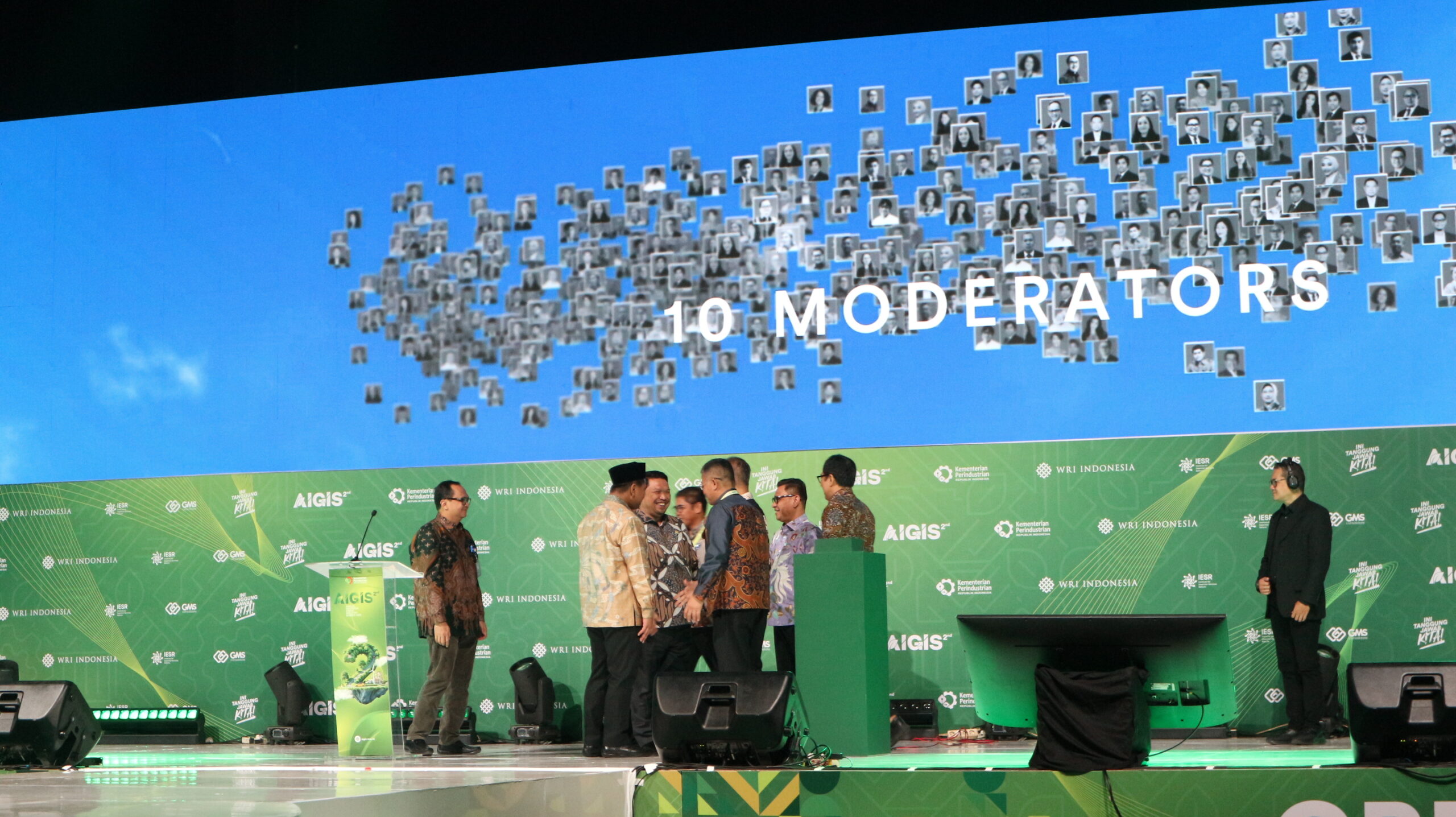

Jakarta, August 21, 2025 — As part of the Annual Indonesia Green Industry Summit (AIGIS) 2025, organized by the Ministry of Industry at the Jakarta Convention Center (JCC) on August 20–22, one of the most notable sessions was Green Talks Panel 3, titled “Dissemination of the Pilot Project on Hydrometallurgy-Based Carbon Capture Utilization (CCU).” The discussion highlighted the outcomes of a pioneering CCU pilot project in Indonesia’s industrial sector, aimed at accelerating national decarbonization targets.
The panel was moderated by Rizky M. Kahfie, Secretary General of the Indonesia CCS Centre (ICCSC), and featured three distinguished speakers: Eko S.A. Cahyanto (Secretary General, Ministry of Industry), Daconi Khotob (President Director, PT Petrokimia Gresik), and Prof. Kenny Hsu (Chairman, UWin Technology).
Accelerating Emission Targets: Ministry of Industry
Eko S.A. Cahyanto underlined that CCU adoption is integral to achieving accelerated decarbonization in Indonesia’s industrial sector.
“If we only follow conventional trends, emission reductions will not be significant. But with innovation and international support, the 40% reduction target can be achieved. Now, we are increasingly confident that we can reach this goal with our own capabilities,” Eko explained.
He further emphasized that CCU provides not only environmental but also economic benefits.
“We are not only capturing carbon, but also producing valuable by-products that reduce import dependency and can potentially be traded through the carbon economic value scheme,” he added.
Implementation at Petrokimia Gresik
Daconi Khotob, President Director of PT Petrokimia Gresik, shared the progress of the pilot project launched earlier in 2025, which focuses on converting CO₂ into soda ash and sodium bicarbonate.
“CO₂, once a greenhouse gas, can now be transformed into high-value products such as soda ash, which Indonesia has long relied on imports for,” he noted.
He acknowledged, however, that technical challenges remain.
“The main technical challenge is how to absorb CO₂ in large volumes with high efficiency. While this is still at the pilot stage, the technical and economic potential for scale-up is very promising,” Daconi explained.
Global Technology Perspective: UWin Technology
From the technology standpoint, Prof. Kenny Hsu highlighted how hydrometallurgy-based CCU differs from conventional methods. The system is more efficient, requiring neither high pressure nor precious metal catalysts.
“With this system, one kilogram of soda ash can be produced while capturing 0.9 kilograms of CO₂. It is not only reducing emissions but also creating added value,” Kenny said.
He expressed optimism that the Indonesian pilot project could become a milestone for the country’s green transition.
“Indonesia has set an accelerated net-zero target, and CCU technology will be a shining star on the path toward a sustainable future,” he remarked.
A Model for Green Industry Collaboration
Moderator Rizky M. Kahfie concluded the session by underscoring the importance of cross-sector collaboration in advancing green innovation. He noted that the CCU pilot project exemplifies how government, industry, and international technology providers can work together to accelerate the transition to a sustainable industrial ecosystem.
Green Talks Panel 3 demonstrated that hydrometallurgy-based CCU is not merely a concept but a tested innovation with strong potential for industrial application. With sustained collaboration, Indonesia is advancing closer to a low-carbon, globally competitive industrial future.