A five-part editorial series by Indonesia Economic Forum, on “Bali Tech Week 2026: Five Days to Shape Indonesia’s Digital Future.”
BALI TECH WEEK 2026 / DAY 4
As Indonesia strengthens its computing infrastructure and technological independence, policymakers and industry leaders confront a larger challenge: ensuring that artificial intelligence creates economic opportunities across the country.
by Sachin V Gopalan, Founder & CEO, Indonesia Economic Forum
BALI, October 22, 2026 — Indonesia’s ambitions in artificial intelligence are entering a more demanding phase. Building data centers, attracting international technology companies and expanding access to advanced computing are important achievements, but they do not automatically create technological independence or economic prosperity. The greater challenge is ensuring that these investments translate into stronger domestic industries, more productive businesses and opportunities extending beyond Indonesia’s established digital economy.
That challenge connected the fourth day’s discussions at Bali Tech Week 2026. At the Sovereign Tech Summit and Digital Economy Policy Forum, government and industry representatives examined the infrastructure, investment and regulatory foundations of Indonesia’s technological future. The wider conference agenda explored how artificial intelligence could become an instrument of inclusive economic growth rather than another technology whose benefits remain concentrated among larger enterprises and better-connected communities.
Vice Minister of Communication and Digital Affairs Nezar Patria placed computing capacity and national technological capabilities at the center of the sovereignty debate. Industry participants examined the commercial requirements for developing that infrastructure, while the AI for All agenda highlighted the importance of making emerging technologies useful to Indonesia’s millions of smaller businesses.
Digital Sovereignty Begins with Computing Power

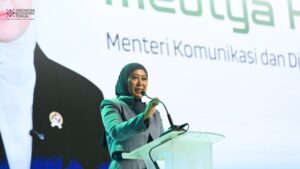
Vice Minister of Communication and Digital Affairs of Indonesia, Nezar Patria shared his remarks during the Sovereign Tech Summit 2026 at Bali Tech Week 2026 in Denpasar, Bali. (Photo: Komdigi)
Nezar Patria’s remarks at the Sovereign Tech Summit offered a practical interpretation of digital sovereignty. Storing data domestically is important, but genuine technological capability also requires access to the computing resources, specialist expertise and industrial supply chains supporting advanced digital systems.
Indonesia’s data-center capacity, estimated at approximately 580 megawatts, is expected to expand toward 1.3 gigawatts by 2027–2028. Yet regional competition is intensifying, particularly from Malaysia, where reported capacity is already substantially larger. These figures illustrate both Indonesia’s investment potential and the infrastructure requirements of an increasingly AI-intensive economy.
Computing power is becoming a strategic economic resource. Advanced AI systems depend on powerful processors, reliable electricity, sophisticated cooling and high-capacity communications networks. Countries unable to secure these resources risk becoming increasingly dependent on external technology providers, even when they possess large domestic markets.
Nezar’s argument extended beyond data centers into semiconductor technology, advanced hardware, research and specialist skills. Indonesia cannot manufacture every component of the global AI supply chain, but it can develop stronger domestic capabilities in strategically important areas while building international partnerships.
Digital sovereignty, therefore, should not be confused with technological isolation. It means strengthening Indonesia’s ability to make independent technology choices, protect critical systems and capture greater economic value from digital innovation without disconnecting from global technology networks.
Four Commitments to Turn Discussion into Action
The Sovereign Tech Summit also produced a more operational agenda. Nezar outlined four follow-up priorities intended to translate Bali Tech Week’s discussions into practical action.
The first involves consolidating conference findings into a national infrastructure assessment within 30 days, covering fiber-optic networks, submarine cables and satellite connectivity. The second focuses on technology adoption through practical pilots involving state-owned enterprises, major corporations and MSMEs. A third priority concerns AI talent development, strengthening cooperation among universities, researchers and industry. The fourth addresses regulatory alignment, including emerging technologies such as low-Earth-orbit satellite services.
As Nezar observed in remarks reported by Indonesian media, “A good forum is measured not only by how lively its discussions are, but by what we do afterward.” The quotation, translated from Indonesian, captures an important challenge facing Bali Tech Week itself.
Indonesia has no shortage of digital economy conferences, investment announcements or technology initiatives. The more difficult task is connecting them into coordinated programs delivering measurable results. The proposed 30-day infrastructure review provides an early benchmark against which progress can be assessed.
Making Sovereign Infrastructure Commercially Useful

Vice President of Sales and Marketing at NeutraDC, Erik Orbandi shared hir views during the Sovereign Tech Summit 2026 at Bali Tech Week 2026 in Denpasar, Bali. (Photo: Komdigi)
TelkomGroup and its data-center business NeutraDC brought a commercial perspective to the sovereignty debate. Erik Orbandi, Vice President of Sales and Marketing at NeutraDC, was identified in post-event coverage of discussions on accelerating enterprise adoption of sovereign digital infrastructure.
Data centers, cloud platforms and advanced computing facilities require substantial investment, but their economic value depends on businesses and institutions using them. Indonesian enterprises need reliable, competitively priced services supporting applications ranging from conventional data processing to sophisticated AI workloads.
Infrastructure investment creates capacity, but it does not automatically generate domestic innovation. Without sufficient demand from Indonesian companies, expensive facilities could contribute less to the national technology ecosystem than anticipated. Conversely, a stronger market for enterprise AI, cloud services and locally developed software can attract further investment, support domestic technology providers and create opportunities for specialist talent.
The government’s emphasis on connecting infrastructure development with practical industry pilots is therefore particularly relevant. Sovereign infrastructure becomes economically meaningful when it supports productive activity and gives businesses genuine choices over technology providers.
Digital Economy Policy: Sovereignty Without Isolation
While the Sovereign Tech Summit concentrated on infrastructure, the Digital Economy Policy Forum examined the regulatory environment in which those investments must operate.
Its agenda addressed ASEAN’s Digital Economy Framework Agreement (DEFA), cross-border data flows, digital taxation, data governance and fair digital markets. These issues reflect an increasingly important tension: governments want greater control over strategic infrastructure and sensitive information, while innovation and digital commerce depend heavily on international connectivity.
An Indonesian technology company may use cloud infrastructure developed abroad, serve customers across ASEAN and rely on international standards to exchange data and conduct transactions. Policies encouraging domestic technological development can strengthen national capabilities, but poorly designed restrictions could increase business costs or discourage investment.
ASEAN’s efforts to establish a more integrated regional digital economy provide an important context. Greater regulatory compatibility and fewer unnecessary barriers to digital trade could help Indonesian businesses reach international markets.
For Indonesia, technological sovereignty and international openness need not be contradictory. The objective is to strengthen domestic capabilities while preserving access to the technologies, partnerships and markets that make them commercially valuable.
AI for All: Closing Indonesia’s Digital Divide
Another important dimension of Day 4 was inclusive AI adoption. The conference’s AI for All: Catalyzing Inclusive Economic Growth in Indonesia session was designed to bring together perspectives from economics, digital literacy and digital public infrastructure.
The published panel lineup named Dandy Rafitrandi, a researcher at CSIS Indonesia; Donny B.U., founder of ICT Watch; and Gopa Kumar T.N., CEO of Protean International DMCC, with Bambang Cahyo Susilo, Co-founder and CFO of Eratani, as moderator.

The “AI for All: Catalyzing Inclusive Economic Growth in Indonesia” session at Bali Tech Week 2026 in Denpasar, Bali.
(Photo: Komdigi)
The session’s central question was whether AI would help close Indonesia’s economic disparities or reinforce them. Research cited in the conference briefing estimated AI adoption at approximately 15% among smaller Indonesian businesses, compared with 63% among large enterprises. The same research suggested that wider adoption by smaller firms could contribute approximately Rp910 trillion, equivalent to 3.8% of GDP, to Indonesia’s economy.
The economic challenge is particularly significant for Indonesia’s large informal workforce and millions of MSMEs. AI could improve inventory management, customer engagement, production planning and access to financial services, but only if applications become affordable and relevant to everyday business needs.
Digital literacy presents another obstacle. Communities without suitable devices, affordable data or sufficient technical skills may remain excluded even when internet connectivity improves. Women, younger workers, informal businesses and regions outside Java face particular risks if technological change advances faster than access to training and opportunity.
Digital public infrastructure offers one possible foundation for broader participation. Protean’s experience in India’s population-scale identity, pension and digital verification systems illustrates how trusted, interoperable infrastructure can support services delivered by multiple institutions. Its AI-enabled agriculture initiative in Ethiopia, combining farmer identification with advisory services in local languages, provides another example of technology designed around practical economic needs.
For Indonesia, the opportunity lies in making AI useful to people who may never interact directly with sophisticated technology platforms. A small retailer could benefit from automated inventory planning, a farmer from localized agricultural advice, and an informal worker from more accessible financial and administrative services.
AI inclusion requires more than distributing software. It requires trusted digital systems, practical applications, relevant skills and institutions capable of delivering services at scale.
From Infrastructure Investment to Economic Value
The fourth day of Bali Tech Week demonstrated why Indonesia’s digital transformation cannot be measured solely through infrastructure statistics. More data centers, stronger computing capacity and additional technology investment are important, but they represent the means rather than the ultimate objective of economic development.
Indonesia’s opportunity lies in combining these investments with domestic innovation, skilled employment, competitive enterprises and services that improve everyday productivity. Infrastructure creates capacity, but skills and applications generate demand. Commercial demand attracts further investment, while effective governance creates confidence among businesses and citizens.
The challenges are interconnected. Advanced computing requires affordable electricity, an issue highlighted earlier in the week by Energy Minister Bahlil Lahadalia. Domestic technology companies need capital and specialist expertise, while smaller enterprises require practical solutions rather than complicated technology offerings.
Cooperation among government, infrastructure providers, technology developers, universities, financial institutions and business communities will therefore be essential. No single organization can independently build the capabilities required for Indonesia’s digital transformation.
The Real Test of Indonesia’s AI Ambitions
By the conclusion of Day 4, Bali Tech Week had moved beyond broad discussions of technological potential toward a more concrete examination of national development priorities.
Nezar Patria’s emphasis on computing capacity established the infrastructure challenge, while the government’s four follow-up commitments introduced measurable next steps. Industry discussions highlighted the importance of commercial adoption, and the Digital Economy Policy Forum reinforced the need for an open, competitive regulatory environment.
The wider conversation about inclusive AI brought these priorities back to the businesses and citizens that digital transformation is ultimately intended to serve.
Indonesia’s digital future will require national capability alongside international cooperation, technological investment alongside commercial adoption, and innovation supported by effective safeguards.
The real test of Indonesia’s AI ambitions will not be how much technology the country builds or controls, but how effectively that technology creates productivity, opportunity and prosperity across its economy.
END
About Bali Tech Week 2026
Bali Tech Week 2026 (BTW 2026) is an initiative of the Ministry of Communication and Digital Affairs of the Republic of Indonesia (Komdigi), jointly managed with DS Group as an umbrella platform for technology events that connects government, industry, founders, investors, and Indonesian and international technology communities to build collaboration and unlock business and partnership opportunities.
The inaugural edition of BTW 2026 will take place on 19–23 October 2026 at the Bali Beach Convention Center, Sanur, Bali, under the theme “Archipelago Ascending — Advance Together, Innovate Further.” Bringing together 13 anchor events in one week under a shared agenda, BTW 2026 spans startups, gaming, artificial intelligence (AI), cybersecurity, digital assets, infrastructure, policy, and investment. BTW 2026 2026 aims to welcome more than 4,000 participants, including 1,000 international delegates, with representation from more than 30 countries.
IEF served as Community Partnership for Bali Tech Week 2026 (https://balitechweek.id/)
please contact:
Indonesia Economic Forum
PT. Chairos International Ventures
Polikarpus Ivan,
Program Manager
polikarpus@indonesiaeconomicforum.com
+62 878 5329 8306