INDONESIA ECONOMIC FORUM | SPECIAL REPORT
From ministers confronting the energy demands of artificial intelligence to technology leaders developing Indonesian-language AI, entrepreneurs pursuing global markets and policymakers strengthening digital sovereignty, Bali Tech Week revealed how Indonesia’s next economic transformation depends on connecting infrastructure, innovation, investment and opportunity.
by Sachin V Gopalan, Founder & CEO, Indonesia Economic Forum
SANUR, BALI, October 23, 2026 — What does it take for a country of more than 280 million people to become not merely one of the world’s largest consumers of digital technology, but a serious creator of it?
That question emerged as the defining theme of Bali Tech Week 2026, which brought together ministers, senior government officials, technology executives, investors, researchers and entrepreneurs for five days of discussions about Indonesia’s digital future.
The gathering generated substantial commercial activity, including 813 startup matchmaking meetings and more than 1,200 business interactions involving the gaming industry. It also brought policy commitments, international research collaboration and renewed attention to the infrastructure required for artificial intelligence.
But the more revealing story was not the number of meetings or technologies displayed. It was how different leaders, approaching Indonesia’s digital economy from different perspectives, illuminated the same national challenge.
An energy minister was addressing the electricity requirements of data centers. Telecommunications leaders were confronting the economics of network investment. AI researchers were developing technologies for Indonesia’s linguistic diversity. Cybersecurity specialists were questioning whether innovation could outpace public trust. Startup founders were seeking international customers, while government officials were developing programs to help digital entrepreneurs emerge beyond Jakarta.
These concerns were interconnected. Together, they suggested that Indonesia’s digital ambitions are evolving from a collection of technology initiatives into a broader economic development agenda.
When an Energy Minister Becomes Central to the AI Debate

Indonesia’s Coordinating Minister for Downstream Development and Energy Transition, Bahlil Lahadalia shared his remarks at Bali Tech Week 2026 in Denpasar, Bali. (Photo: Komdigi)
One of the most revealing connections came through Minister of Communication and Digital Affairs Meutya Hafid and Energy and Mineral Resources Minister Bahlil Lahadalia.
At first glance, energy policy might appear peripheral to a technology conference. In reality, it is becoming central to the economics of artificial intelligence.
Every major AI installation depends on electricity, cooling systems, advanced processors and reliable communications infrastructure. The expansion of data centers therefore creates demands that cannot be addressed by telecommunications policy alone.
Bahlil’s participation highlighted the relationship between digital investment and Indonesia’s wider industrial and energy strategy. Data centers may attract substantial foreign capital, but their contribution to national development will also depend on whether they create opportunities for Indonesian suppliers, workers and businesses.
Generating sufficient electricity nationally is not the same as ensuring affordable, reliable power where advanced computing facilities are developed. Grid capacity, energy costs, cooling requirements and sustainability will increasingly influence investment decisions.

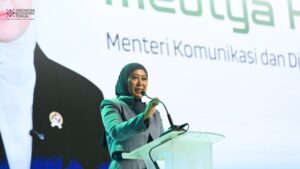
Indonesia’s Minister of Communication and Digital Affairs, Meutya Hafid shared her remarks at Bali Tech Week 2026 in Denpasar, Bali. (Photo: Komdigi)
Meutya’s framework of Terhubung, Tumbuh, Terjaga — Connected, Growing and Protected — provided the broader policy context. Connectivity must enable economic growth, while protection and trust must keep pace with technological adoption.
That relationship between physical infrastructure and digital ambition was reinforced by Vice Minister of Communication and Digital Affairs Nezar Patria, who emphasized computing capacity as a strategic component of technological sovereignty.
Indonesia’s data-center capacity, reported at approximately 580 megawatts, is expected to expand toward 1.3 gigawatts by 2027–2028. Yet competing regional markets are investing aggressively in similar infrastructure.
Nezar connected technological sovereignty to advanced hardware, research, specialist skills and the ability to make independent technology choices. The policy challenge is not whether Indonesia should cooperate with international technology providers, but how it can benefit from that cooperation while developing stronger domestic capabilities.
He outlined four follow-up priorities: national infrastructure mapping, practical technology adoption pilots, AI talent development and regulatory alignment. The proposed infrastructure assessment within 30 days offered an early test of whether conference discussions would lead to implementation.
The connection between Bahlil’s energy perspective and Nezar’s sovereignty agenda was unmistakable: Indonesia cannot become a competitive AI economy without aligning energy investment, computing infrastructure and industrial development.
The Telecommunications Leaders Facing a New Investment Equation

Deputy Minister of Communication and Digital Affairs, Angga Raka Prabowo shared his remarks at Bali Tech Week 2026 in Denpasar, Bali. (Photo: Komdigi)
If energy provides the power behind Indonesia’s digital ambitions, telecommunications networks provide the means to distribute their benefits.
Vice Minister Angga Raka Prabowo brought attention to the investment conditions facing Indonesia’s telecommunications operators. He highlighted regulatory costs estimated at 13–14% of operator revenues and the importance of creating greater room for infrastructure investment.
His remarks raised a fundamental question. How can Indonesia expand affordable connectivity, particularly beyond its most commercially attractive urban markets, while ensuring that operators retain sufficient resources to invest in advanced infrastructure?
The discussion involved telecommunications executives including Telkom Indonesia President Director Nanang Hendarno, Telkomsel President Director Nugroho, and industry participants Desmond Cheung and Merza Fachys.
Their perspectives reflected an industry whose role is changing. Telecommunications networks are no longer simply channels for calls and internet access. They increasingly support cloud services, enterprise applications, financial transactions, digital public services and AI-enabled businesses.
This infrastructure perspective was complemented by Erik Orbandi, Vice President of Sales and Marketing at NeutraDC, whose participation in discussions on sovereign digital infrastructure brought the commercial dimension into focus.
Data centers and advanced computing facilities require significant investment, but their economic value depends on businesses using them. Indonesia must therefore develop demand for cloud computing, enterprise AI and locally relevant applications alongside the infrastructure needed to deliver those services.
Infrastructure investment without commercial adoption risks producing underused capacity, while digital innovation without adequate infrastructure may struggle to scale.
The Government Officials Connecting Policy to Economic Outcomes

Dr. Ismail (left) and GoTo CEO Hans Patuwo (right) speaking during the “SEA as Global Leader in Digital Technology & Innovation” panel session at Bali Tech Week 2026 in Denpasar, Bali. (Photo: Komdigi)
Behind the ministerial discussions, senior officials at the Ministry of Communication and Digital Affairs were examining how infrastructure, investment and innovation could become measurable economic outcomes.
Komdigi Secretary General Dr. Ismail participated in a discussion with GoTo Group CEO Hans Patuwo about Southeast Asia’s role in technology and innovation.
The conversation coincided with GoTo’s announcement of a 27-billion-parameter open-source large language model supporting Indonesian and several regional languages, including Javanese, Sundanese, Balinese and Bataknese.
For a country with Indonesia’s linguistic diversity, this development has implications beyond technological prestige. More capable Indonesian-language AI could support education, customer service, commerce and public information, expanding access for communities underserved by mainstream technology products.
Edwin Hidayat Abdullah, Director General of Digital Ecosystem at Komdigi, connected this innovation agenda with investment, talent and commercial opportunity.
Across the week’s discussions, Edwin emphasized the need to develop AI engineers, cybersecurity professionals, data scientists and educators while encouraging investment in domestic technology businesses.
He outlined the government’s ambition to facilitate approximately Rp1 trillion in startup investment during 2026, with around Rp400 billion reported as achieved at the time. This was a broader annual investment objective, not a claim that Bali Tech Week had generated that amount.
At the event’s conclusion, Edwin discussed government estimates that Indonesia could attract $8 billion to $12 billion in AI-related investment between 2026 and 2030.
The distinction between ambition and achievement remains essential. Projected investment potential is not committed capital, and startup meetings are not completed financing rounds.
Yet Edwin’s contribution illustrated how the government’s digital ecosystem agenda is expanding beyond connectivity toward investable companies, skilled employment and commercially useful technologies.
Dr. Sonny Hendra Sudaryana, Director of Digital Ecosystem Development at Komdigi, brought an equally important implementation perspective through Garuda Spark, the government’s initiative to strengthen Indonesia’s digital innovation ecosystem.
Aligned with the ministry’s Terhubung, Tumbuh, Terjaga priorities, Garuda Spark seeks to connect digital talent, startups, mentors, industry partners and regional innovation communities. The initiative’s development has included expansion toward 10 hubs and 60 spokes, with more than 15,700 digital talents reached through 178 programs.
Sonny’s contribution illustrates the difference between announcing technology ambitions and building the institutions needed to deliver them. Indonesia’s digital transformation cannot depend exclusively on investment in Jakarta or the growth of a handful of major technology companies. It requires regional innovation networks capable of identifying talent, nurturing entrepreneurs and connecting promising businesses with commercial opportunities.
This creates a practical connection between Edwin’s investment agenda and Sonny’s ecosystem-development efforts. Capital can help technology companies expand, but sustained innovation requires a pipeline of skilled people, early-stage enterprises, mentors and customers.
Garuda Spark represents an effort to develop that pipeline across Indonesia.
Together, the two officials highlighted complementary requirements for Indonesia’s digital future: attracting capital to scale promising businesses and building the nationwide talent and innovation ecosystem from which those businesses emerge.
AI Sovereignty Is Also About Language, Research and Talent

Hammam Riza (right) and William Tjhi (left) shared their views during the AI Impact Summit (AIIS) 2026 at Bali Tech Week 2026 in Denpasar, Bali. (Photo: Antara)
Infrastructure sovereignty is only one dimension of technological independence. Another concerns the ability to develop AI systems that understand Indonesia’s languages, institutions and economic requirements.
That challenge was illustrated by Project NUSA, a collaboration involving Indonesia’s AI research community and AI Singapore.
Hammam Riza, Chairman of KORIKA, and William Tjhi of AI Singapore presented the initiative as an opportunity to combine research capabilities with Indonesia’s diverse linguistic and social environment.
The partnership recognizes that countries need not develop every technological component independently to build meaningful national capabilities. International research cooperation can accelerate progress while enabling the development of models and applications suited to domestic requirements.
Coordinating Minister for Economic Affairs Airlangga Hartarto, addressing the AI Impact Summit virtually, connected artificial intelligence with Indonesia’s broader economic ambitions.
His perspective placed AI within the national productivity agenda rather than treating it as an isolated technology industry.
Indonesia’s economic returns from AI will depend not only on developing sophisticated models, but also on applying them across manufacturing, agriculture, financial services, logistics and other sectors.
A locally relevant AI system becomes economically valuable when it helps a business reduce costs, improve productivity, access information or reach customers.
The combined perspectives of Airlangga, Ismail, Hammam Riza, William Tjhi and Hans Patuwo pointed toward a common objective: Indonesia must move beyond technology consumption toward developing and applying technologies that create domestic economic value.
Why Trust May Determine the Speed of Digital Growth

Slamet Aji Pamungkas, Deputy Head of Indonesia’s National Cyber and Crypto Agency (BSSN),
speaking during AICX 2026 at Bali Tech Week 2026 in Denpasar, Bali. (Photo: Komdigi)
The expansion of digital infrastructure and AI capabilities also exposed a less visible constraint on Indonesia’s ambitions: public trust.
Meutya Hafid’s discussions with Singapore’s Minister for Digital Development and Information Josephine Teo, and her engagement with Malaysia’s Communications Minister Fahmi Fadzil, brought regional cooperation on online safety and digital governance into the wider economic conversation.
The protection of children online was a particularly important concern. As digital platforms become embedded in everyday life, governments face increasing pressure to ensure that innovation does not come at the expense of public safety.
Cybersecurity specialists reinforced this message.
Patrick Dannacher, President Director of ITSEC Asia, emphasized that AI and cybersecurity are strategic concerns for corporate leadership, affecting business continuity, competitiveness and national interests.
Slamet Aji Pamungkas, Deputy Head of Indonesia’s National Cyber and Crypto Agency (BSSN), brought the national security perspective, stressing the importance of integrating cybersecurity into technological development.
Digital fraud, data breaches, identity theft and AI-enabled deception can undermine confidence in online transactions and services. Businesses may become more reluctant to adopt new technologies, while consumers may hesitate to participate in unfamiliar digital systems.
Trust therefore has economic value. Secure systems, responsible governance and predictable regulation help create the conditions under which investment and innovation can flourish.
The regional dimension is equally significant. Indonesia’s technology companies increasingly operate within an interconnected ASEAN economy, where compatible safeguards and regulatory cooperation can support cross-border commerce.
The challenge is strengthening protection without creating unnecessary barriers to competition or innovation.
From Closed Platforms to Open Economic Opportunity

T. Koshy (left) shared his views about Open Network during Bali Tech Week 2026 in Denpasar, Bali. (Photo: Komdigi)
Perhaps the most consequential question raised during Bali Tech Week was how the benefits of digital transformation could reach Indonesia’s millions of MSMEs and informal workers.
The AI for All conference agenda examined the gap between technology adoption by large corporations and smaller enterprises.
Its published program identified Dandy Rafitrandi of CSIS Indonesia, Donny B.U. of ICT Watch and Gopa Kumar T.N. of Protean International DMCC, with Bambang Cahyo Susilo of Eratani as moderator. Their individual remarks and attendance have not been independently established through post-event reporting, so the panel’s documented themes are more reliable than attributing statements to particular participants.
Those themes were substantial: affordable AI, digital literacy, financial inclusion, agricultural productivity and the role of digital public infrastructure.
The discussion of interoperable digital commerce introduced a related question: must every small business depend on a large, closed digital platform to participate in online markets?
T. Koshy, founding Managing Director and CEO of India’s Open Network for Digital Commerce (ONDC) and a Commissioner of Indonesia Open Network (ION), brought experience from India’s effort to establish open, interoperable commerce infrastructure. His session, moderated by Alvin Evander, examined how shared standards can support fairer access to digital markets.
Interoperable networks offer a different approach from conventional platform models. Buyers, sellers, logistics providers and financial institutions can participate through different applications while transacting across a shared network.
For smaller businesses, the potential benefits include greater access to customers, logistics services, financing and technology tools without relying exclusively on a single dominant intermediary.
Protean’s experience in India’s digital identity, pension and verification infrastructure provides another example of how shared digital systems can support services delivered by multiple institutions.
These approaches are not guaranteed solutions to Indonesia’s digital inclusion challenges. They require adoption, governance, viable commercial models and effective consumer safeguards.
But they introduce an important possibility: AI and digital infrastructure could become tools for widening economic participation rather than reinforcing the advantages of already-dominant companies.
The Entrepreneurs Turning Digital Ambition into Exports

The IGDX game exhibition at Bali Tech Week 2026 in Denpasar, Bali. (Photo: Komdigi)
While policymakers debated infrastructure and regulation, entrepreneurs demonstrated what Indonesia’s digital economy could produce.
The Indonesia Game Developer Exchange provided one of the clearest examples.
Shafiq Husein, Chairman of the Indonesian Game Association, highlighted the scale of participation by domestic developers and the importance of international industry engagement.
Closing coverage reported more than 1,200 business meetings involving Indonesian game studios and international publishers. Reports differed on the precise number of participating studios, citing 244 and 339 respectively, but consistently pointed to substantial international commercial engagement.
Successful game developers create intellectual property that can be distributed globally. Their businesses employ software engineers, designers, animators, writers and other specialists whose skills can support a wider creative technology industry.
The industry’s challenge is converting talent into sustainable enterprises capable of financing development, reaching international audiences and retaining the value of their intellectual property.
The same commercial challenge was visible in HUB.ID’s startup matchmaking program, which reported 813 business meetings involving 85 selected startups, 40 venture capital firms and 35 international corporations.
These meetings represent opportunities rather than completed transactions. Their economic value will depend on whether introductions lead to financing, corporate pilots, commercial contracts and international expansion.
Nevertheless, the two programs illustrated an important transition. Indonesia’s technology industry is increasingly seeking opportunities not only to serve domestic consumers, but to create products, intellectual property and businesses capable of competing globally.
The New Economics of Indonesia’s Digital Future
Viewed together, the contributions of Indonesia’s ministers, senior officials, industry executives, researchers and entrepreneurs revealed relationships that will shape the country’s economic future.
Meutya Hafid’s priorities require infrastructure that Bahlil Lahadalia’s energy sector must help support. Angga Raka Prabowo’s regulatory concerns influence whether telecommunications companies can finance network expansion. Nezar Patria’s sovereignty agenda depends on computing capacity, technical skills and investment.
Ismail’s engagement with domestic AI development connects research and language technology to national capability. Edwin Hidayat Abdullah’s investment agenda seeks to translate that capability into commercially viable enterprises, while Sonny Hendra Sudaryana’s Garuda Spark initiative aims to nurture the talent and regional innovation networks needed to sustain that growth.
The perspectives of Josephine Teo, Fahmi Fadzil, Patrick Dannacher and Slamet Aji Pamungkas demonstrate that innovation also depends on security, public confidence and international regulatory cooperation.
Meanwhile, Hammam Riza, William Tjhi, Hans Patuwo, T. Koshy and Indonesia’s emerging game developers illustrate different ways in which domestic innovation and international partnerships can create economic value.
These are not separate stories. They are components of the same transformation.
A data center becomes more valuable when Indonesian businesses can use its computing capacity. An AI model becomes more useful when it understands local languages and solves practical problems. A telecommunications network becomes more productive when it enables commerce, finance and public services.
A startup becomes more sustainable when investment leads to customers and revenue. A game developer contributes more to the national economy when its intellectual property reaches international markets. Digital public infrastructure becomes more meaningful when it expands opportunities for businesses and citizens previously excluded from modern economic systems.
The central challenge is connecting these components into a functioning economic ecosystem.
The Real Outcome Will Be Measured Beyond Bali
Bali Tech Week 2026 demonstrated Indonesia’s growing ability to convene government leaders, international partners, technology companies, investors and entrepreneurs around shared national priorities.
The reported business meetings, research partnerships and policy commitments provide evidence of meaningful engagement. Yet the longer-term economic outcomes remain to be established.
The next measures of success should be more demanding: how much investment is actually deployed, how many startups secure commercial customers, how many Indonesian-developed technologies reach international markets, how many skilled jobs are created and how many MSMEs experience measurable productivity gains.
The government’s infrastructure commitments will require implementation. AI research partnerships will need to produce useful applications. Cybersecurity and regulatory reforms will need to strengthen confidence without discouraging innovation. Open networks and inclusive digital services will need to demonstrate that they can expand participation on commercially sustainable terms.
These outcomes will depend on continued cooperation among the same communities that gathered in Bali.
The significance of Bali Tech Week was therefore not that it resolved Indonesia’s digital challenges, but that it revealed how closely those challenges are connected — and how many different leaders and institutions must contribute to solving them.
Indonesia possesses a large digital market, growing technical talent, ambitious policymakers and increasing international interest. The opportunity now is to turn those advantages into domestic capabilities, globally competitive enterprises and broader economic prosperity.
Indonesia’s digital future will not be determined by any single technology, company or government program. It will be shaped by how effectively the country connects the people building its infrastructure, the innovators creating its technologies, the businesses adopting them and the citizens whose lives they are intended to improve.