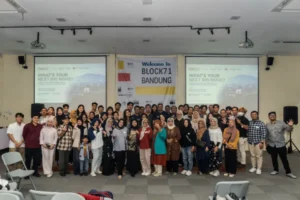
JAKARTA — Indonesia Open Network (ION), in collaboration with Garuda Spark Innovation Hub (GSIH) Jakarta, held ION Build: Build on the Open Network – A Connector for Digital Commerce & Interoperable Solutions at Garuda Spark Innovation Hub, FX Sudirman, Jakarta, on Friday (Oct. 2, 2026). Supported by Google.org and Indosat Ooredoo Hutchison, the event brought together startups, founders, developers and business players to discuss the use of open networks and interoperability in building a more connected digital commerce ecosystem.
The event introduced the concept of digital public infrastructure (DPI) and Indonesia Open Network as infrastructure that enables various digital players and services to connect with one another. Discussions focused on how interoperability can open access to markets, services, partners and new business opportunities amid an increasingly fragmented digital ecosystem.
GSIH Promotes Collaboration Across the Digital Ecosystem

In his remarks, Mizan Lazuardi of Garuda Spark Innovation Hub (GSIH) welcomed the collaboration with ION and expressed hope that the event would benefit participants while strengthening synergy among the parties involved. He explained that GSIH is part of a digital talent and entrepreneurship development program focused on strengthening the digital ecosystem across Indonesia.
In a video opening address, Shinta Kamdani highlighted the importance of connectivity in creating new opportunities for businesses. She said many opportunities cannot be created by a single party, but instead emerge through connections with experience, partners, platforms, technology services and broader markets.
She encouraged business players to look beyond simply asking how to improve their businesses and instead consider what could happen if they were connected to more opportunities around them.
Open Network Creates Opportunities for Startups
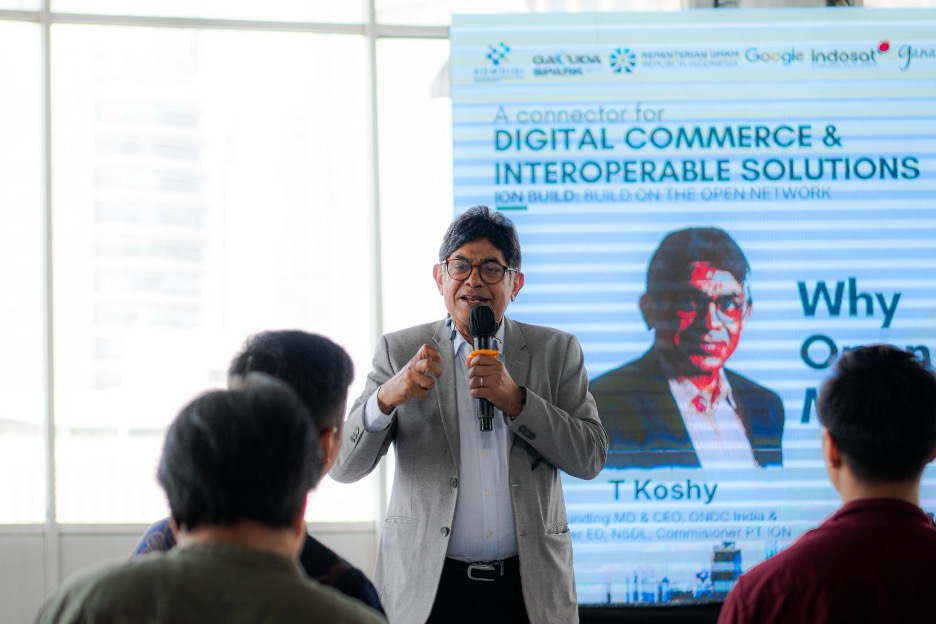
The benefits of open networks were further explored by T. Koshy, Founding MD & CEO of ONDC India and Former Executive Director of NSDL. Koshy explained that a digital commerce ecosystem concentrated around specific platforms can create challenges for small businesses seeking customers, suppliers and supporting services.
Through an open network, various services can be made available within the network and accessed through interoperable protocols.
“Compared to a platform-centric world, in an open network you have humongous possibility.”
Koshy also illustrated how businesses can utilize services already available within the network without having to build every connection separately. He said this approach can allow small businesses to focus on their core capabilities while leveraging services provided by other players.
“That is the beauty of an open network. It lets you make money out of what you are good at, whether you are big or whether you are small.”
He also shared India’s experience in implementing open networks as one of the lessons Indonesia can learn from.
ION Positioned as Infrastructure Beneath Platforms

Dr. Bayu Prawira Hie, CEO of Indonesia Open Network, explained ION’s position within the digital ecosystem. He emphasized that ION is not a platform replacing existing digital platforms, but infrastructure operating beneath various platforms and services.
“But the truth is, we’re actually the underlying infrastructure for the platform. So the existing marketplace platforms—whether they’re green, orange, blue, or any other color—can also use the Indonesia Open Network.”
According to Bayu, this approach allows platforms, businesses and service providers to continue performing their respective roles while connecting through infrastructure governed by common rules and standards.
He used the analogy of a public road to describe the open network concept, where different players can connect and conduct business while following established rules.
Bayu also highlighted the benefits of interoperability for buyers and sellers. Sellers can gain access to more buyers, while buyers can have more sellers to choose from.
“If we look at it from the seller’s perspective, they are happy because they can reach more buyers. Buyers are also happy because they have more sellers to choose from.”
He added that common rules and standards can make connections between buyers and sellers faster and easier.
“The rules of the game are standardized. So buyers can find sellers more quickly and easily, and sellers can find buyers more quickly and easily.”
Government Highlights Distribution of Digital Economic Value

From the government perspective, Dr. Sonny Hendra Sudaryana, Director of Digital Ecosystems Development at the Ministry of Communication and Digital Affairs (Komdigi) of the Republic of Indonesia, positioned digital ecosystem development as part of efforts to drive economic growth, productivity and job creation.
Sonny highlighted the potential of Indonesia’s e-commerce sector and the role of MSMEs in digital commerce.
“If we look at where we are now, we are the third largest in terms of e-commerce society, and 80 percent is driven by MSMEs. This is a very significant potential.”
He also emphasized that Indonesia is currently experiencing a demographic bonus that needs to be utilized to strengthen digital capabilities and entrepreneurship.
“We are experiencing a demographic bonus that will only last until 2035. We have to maximize this energy over these nine years.”
In his presentation, Sonny outlined several layers of the digital ecosystem, ranging from physical infrastructure and virtual infrastructure or digital public infrastructure to platforms and integration, as well as services and applications.
He also highlighted three important elements for digital ecosystem development: connectivity, capital and competency, including talent and digital literacy.
According to Sonny, digital economic development should ensure that the value generated is distributed more broadly while maintaining a balance between competition, consumer protection and innovation.
“The government’s task is to balance competition, consumer protection and innovation.”
Looking ahead to 2035, Sonny cited a target of developing 1,000 technology companies and 4 million digital talents and digital entrepreneurs.
From Digitalization to Integration

The discussion continued with a panel featuring Tutus Kusuma, Head of Operations at Indonesia Open Network; Deni Krida Laksana, President Director of HaloJe Delivery Indonesia; and Eka Citra, Chief Commercial Officer of Olsera.
Tutus explained that interoperability can expand connections across sectors. According to him, an open network can connect not only warungs with e-commerce, finance and technology services, but also supply chains, food and agriculture, and hospitality.
“Not only warungs with e-commerce, finance and technology, but also supply chains, food and agriculture, and hospitality.”
He also emphasized that not every digital service needs to be handled by a single party. In a more open system, different service providers can take on different roles while remaining connected.
“Not every service or digital service needs to be handled by a single party.”
From the logistics business perspective, Deni Krida Laksana highlighted the importance of turning digital visibility into transactions. He said a business’s digital presence should not simply generate attention or followers, but should also encourage actual business activity.
“What HaloJe does is that we do not want our visibility to simply make us visible to people, turning them into followers. We want our visibility to turn people into transactions.”
Deni also emphasized the importance of collaboration among business players.
“We should not operate on our own. We need to collaborate with others so that we have opportunities to grow.”
Meanwhile, Eka Citra addressed the challenges that emerge when digitalization is not accompanied by system integration. A business may use multiple applications and digital channels, but that does not necessarily mean its business processes are connected.
“Digital does not necessarily mean integrated.”
He explained that merchants may receive orders through multiple channels, use different payment institutions, and manage sales, inventory, financial and customer communication data through separate systems. This can create new challenges when the systems cannot communicate with one another.
“Digitalization without integration can create new inefficiencies.”
Eka therefore emphasized that the goal of digitalization should not simply be to use more applications, but to create a more seamless experience and deliver greater value to businesses.
“Don’t just add features. What matters is adding value.”
Participant Sees Potential for Startups
The participant perspective came from Feriska Oktarina, CEO of CSI Brandify, who attended ION Build. She said she found ION interesting because it introduced infrastructure capable of connecting different businesses.
“I just learned that there is this kind of infrastructure that can connect different businesses.”
Feriska sees the approach as having the potential to help startups build connections with a broader business ecosystem, including other businesses and banks. She also welcomed initiatives that encourage young people to enter entrepreneurship and the creative sector.
Building a More Connected Digital Ecosystem
Through ION Build, ION and GSIH brought together perspectives from the government, digital infrastructure developers, technology companies, service providers and startups to discuss interoperability and opportunities in the digital economy.
Support from Google.org and Indosat Ooredoo Hutchison also contributed to the forum, which brought the startup and technology community together to explore the development of open networks in Indonesia.
The discussions highlighted that open networks are not only about technological connectivity, but also address market access, business visibility, service integration, collaboration and the distribution of value across the digital ecosystem.
For startups and businesses, the approach creates opportunities to remain focused on their core capabilities while leveraging connections with other players. For the broader digital ecosystem, interoperability can enable different services and businesses to work together through shared infrastructure and common rules.