
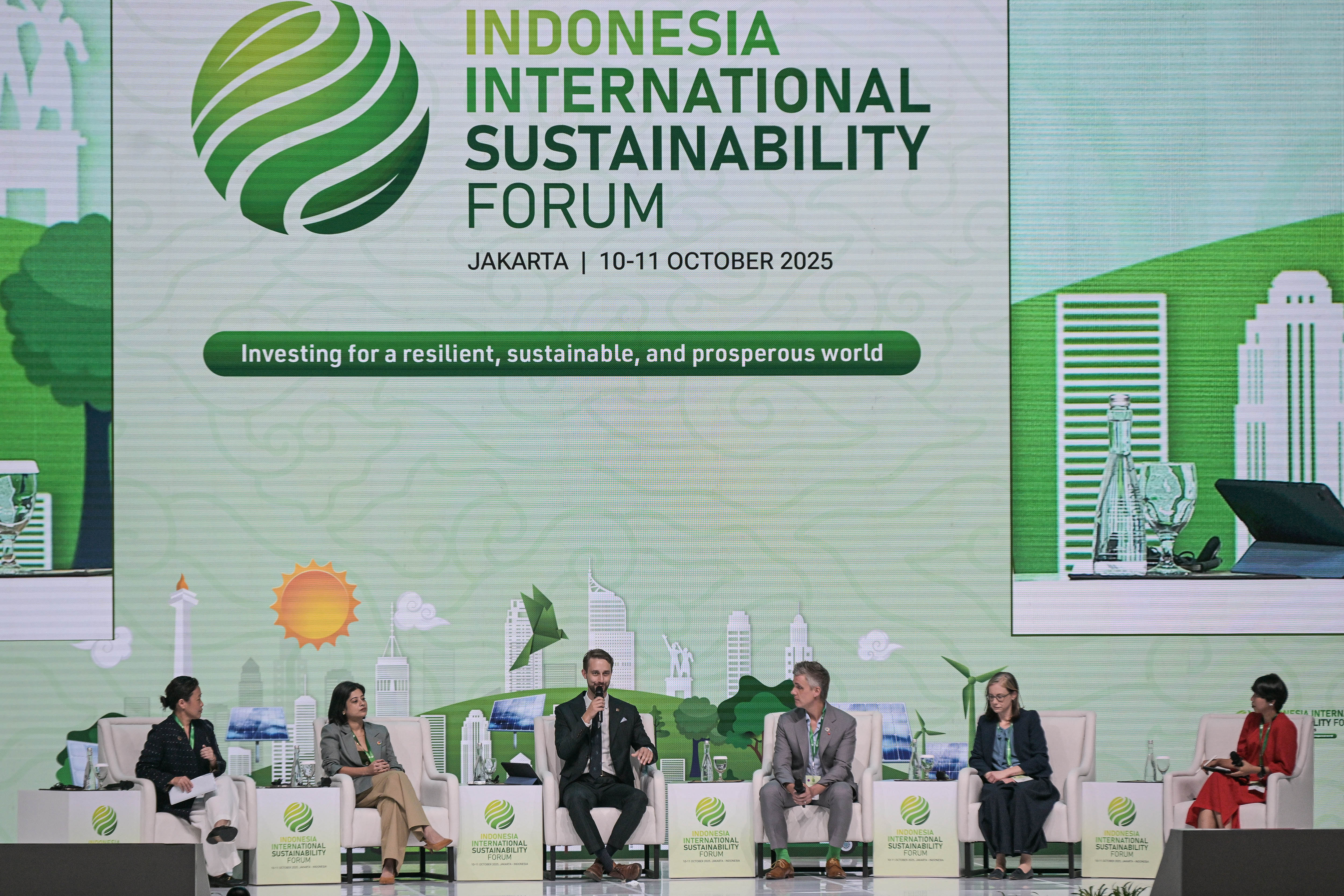

Jakarta, October 10, 2025 — At the Indonesia International Sustainability Forum (ISF) 2025, a panel session titled “Green Growth, Blue Economy: Investing in Nature for Indonesia’s Future” convened experts from finance, conservation, and industry to discuss how Indonesia can pursue economic growth while protecting nature and communities. Moderated by a government representative, the session featured Jan Yoshioka of Conservation International, Pallavi Kalita of Business for Nature, Bjorn Fonden of the International Emissions Trading Association (IETA), Helge Muenkel of DBS Bank, and Amy Merrill of the Integrity Council for the Voluntary Carbon Market (ICVCM). The panelists emphasized that sound policies, credible carbon markets, public–private partnerships, and community engagement are all critical to unlocking funding for nature-based solutions and climate action.
Jan Yoshioka emphasized that with Indonesia’s vast mangrove ecosystems, strong policy frameworks are needed to integrate nature into development. He noted that steps like a new national blue economy plan signal the government’s commitment to investors.
Pallavi Kalita observed that nature-based solutions currently receive only “a fraction of global climate finance,” despite their high benefits for climate and communities. She urged that climate and biodiversity policies be aligned so that protecting nature becomes a core development strategy rather than an afterthought. Kalita also encouraged companies to treat nature as a strategic priority, not just a check-the-box corporate social responsibility effort.
Amy Merrill emphasized that “trust through integrity and robust frameworks” is essential to unlocking private investment in nature. Clear standards and transparency at every level of the carbon market, she explained, give investors the confidence to fund projects.
Government alone cannot achieve Indonesia’s sustainability goals — businesses must be partners as well. Kalita noted that Malaysia created a “Business and Biodiversity” platform to give companies a voice in environmental policy, and Indonesia is now taking a similar approach with support from the Environment Ministry and Bappenas. “It was an opportunity for businesses to be part of the process and for the government to hear what’s working,” Kalita said, emphasizing that public–private collaboration leads to better solutions.
Helge Muenkel pointed out that “more than half of global GDP depends on nature’s services,” yet those benefits are largely taken for granted. Muenkel urged banks and investors to embed nature into their decision-making, just as they are starting to account for climate risks. He also highlighted blended finance – mixing public and private capital – as a way to fund green initiatives if backed by clear policies.
Bjorn Fonden underscored the opportunity for Indonesia in emerging carbon markets under Article 6 of the Paris Agreement. He said hundreds of companies are eager to invest in Indonesian carbon offset projects if the right conditions are in place, and urged the country to capitalize on this interest. With carbon trading now under greater oversight, Fonden argued that clear rules and adoption of global standards like Article 6 and the Core Carbon Principles will draw significant investment. Carbon credits must evolve from niche projects into a standardized commodity to scale up funding, he noted, adding that he is optimistic Indonesia will move in that direction.
Local communities and Indigenous Peoples must be central to climate solutions, the panelists agreed. Merrill described how the Integrity Council’s Indigenous Peoples and Local Communities forum brings grassroots voices into carbon market governance. By integrating traditional knowledge and ensuring communities directly benefit from projects, this approach makes climate initiatives more equitable and effective. “You have to go right back to the people who do the work,” Merrill said, emphasizing that inclusive, bottom-up efforts build the long-term trust needed for success.
Indonesia’s shift toward a nature-positive “green and blue” economy is underway, they observed. “The market is ready; the finance is waiting to flow,” Fonden remarked, suggesting that global investment will follow if the right frameworks are in place. By keeping nature at the center of development and upholding integrity and inclusion, they concluded, Indonesia can secure a sustainable future that benefits its people, its economy, and its environment.