A five-part editorial series by Indonesia Economic Forum, on “Bali Tech Week 2026: Five Days to Shape Indonesia’s Digital Future.”
BALI TECH WEEK 2026 / DAY 2
Meutya Hafid’s bold move in bringing government, energy, telecommunications and technology leaders together reveals a bigger ambition: orchestrating Indonesia’s digital transformation as one national ecosystem.
by Sachin V Gopalan, Founder & CEO, Indonesia Economic Forum
SANUR, BALI, October 19, 2026 — When Indonesia’s Minister of Communication and Digital Affairs, Meutya Hafid, invited Energy and Mineral Resources Minister Bahlil Lahadalia to the opening of Bali Tech Week 2026, it seemed an unusual choice for a technology gathering. Yet his presence made an essential point: artificial intelligence, cloud services and digital commerce depend on the same physical foundations as the rest of the economy. Every data center needs electricity, cooling and connectivity. By putting energy alongside telecommunications and AI, the opening day framed Indonesia’s digital transformation as a national development challenge rather than a technology-sector project.
Meutya Hafid’s Three Priorities: Connected, Growing and Secured
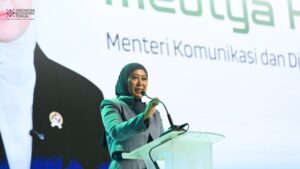
Opening the inaugural Bali Tech Week at the Bali Beach Convention Center in Sanur, Meutya outlined three priorities: Terhubung, Tumbuh, Terjaga — Connected, Growing and Secured. Connectivity remains fundamental in an archipelago where geography makes reliable access expensive and uneven. But with roughly 235 million internet users, the policy question is increasingly what Indonesians can do with that access. Meutya’s second priority, growth, calls for stronger domestic technological capabilities, more productive businesses and digital services that generate economic value rather than simply consumption.
The third priority, secured, is equally important. Digital adoption cannot remain healthy if users face fraud, identity theft, misuse of personal data or risks to children online. Meutya’s framework connects these responsibilities: infrastructure enables participation, innovation turns participation into opportunity, and public trust sustains both. The emphasis also places AI governance, industry-relevant digital talent and data protection within a single national agenda.
Meutya argued that Indonesia should shape the pace and direction of its own AI development according to national needs, while continuing to collaborate internationally. That ambition requires more than policy statements. Government agencies, technology firms, universities, network operators and investors must work from compatible priorities, with clear responsibilities for building infrastructure and translating innovation into practical applications.
The Energy Minister’s Perspective on Digital Infrastructure

Bahlil Lahadalia’s address supplied a reminder of the physical demands behind the AI economy. Large data centers require continuous power, cooling and dependable supporting infrastructure. He discussed estimates that Indonesia’s growing data-center industry could need as much as 20 gigawatts of additional electricity capacity, or 20,000 megawatts. The scale of that potential demand means decisions about power generation and grids will directly affect Indonesia’s ability to attract and sustain digital investment.
Bahlil identified Batam, Karimun and Bintan as potential locations for new data-center development, arguing that infrastructure planning should consider land, water, energy supply and regional opportunities rather than concentrate every investment around established metropolitan centers. He also linked future power expansion and renewable-energy projects to Indonesia’s attractiveness as a digital infrastructure destination. Other countries have encountered constraints on data-center growth because electricity and water systems could not keep pace; Indonesia has an opportunity to plan earlier.
His remarks also raised a question of domestic economic benefit. Data centers may bring significant capital investment, but their contribution should extend to Indonesian suppliers, workers and businesses. That principle aligns with a broader industrial strategy in which infrastructure investment builds local capabilities. There are practical hurdles: national generating capacity does not guarantee affordable, reliable or low-carbon electricity at a particular site, while water use, cooling, grid access and commercial demand all require detailed assessment. Nonetheless, the energy minister’s participation made clear that digital planning cannot be separated from industrial and regional planning.
Connecting the Nation Means Connecting the Ecosystem
The opening day was structured to bring normally separate communities into the same conversation. Director General of Digital Ecosystem Edwin Hidayat Abdullah described an event combining 13 technology programs, with policymakers, telecommunications companies, startups, investors, universities and international participants sharing a common setting. Komdigi reported nearly 1,000 registered one-to-one business meetings by the end of the first day, with an ambition of about 2,000 during the week. Meetings are not investments, but they create opportunities for cooperation that isolated conferences and sectoral initiatives may miss.
The significance is organizational as much as commercial. Indonesia already has substantial digital infrastructure, entrepreneurial talent and public-sector initiatives; connecting them to one another can help reduce duplication and identify gaps between policy, financing and implementation. Bali Tech Week’s wider experiment is whether a large and diverse ecosystem can begin to act with greater coordination.
From Digital Connectivity to National Technological Capability

The discussion of domestic AI capability provided one of the day’s most concrete developments. Komdigi Secretary General Dr. Ismail joined GoTo Group CEO Hans Patuwo in a conversation about Southeast Asia’s role in technology and innovation. GoTo announced a 27-billion-parameter open-source large language model supporting Indonesian and several regional languages, including Javanese, Sundanese, Balinese and Bataknese. For a multilingual country, local-language AI is more than a technical achievement: it could improve access to tools and services that global models may not fully adapt to Indonesian cultural and linguistic contexts.
Open availability could allow researchers, universities, startups and businesses to build applications without starting from scratch. The more difficult test will be adoption: whether those tools can help merchants, educators, public agencies and enterprises solve real problems. Meutya’s ambition to move Indonesia from consuming technology to creating it will ultimately be measured in those uses, not only in model specifications.
Telecommunications: The Next Network Must Do More

Telecommunications leaders considered how Indonesia’s networks must evolve as basic connectivity expands. Telkom Indonesia President Director Nanang Hendarno brought the national infrastructure perspective, while Vice Minister Angga Raka Prabowo spoke about regulatory reform and the investment conditions needed for affordable connectivity. Angga highlighted the burden of regulatory costs on operators, estimated at 13–14% of revenue, and the importance of creating room for further network investment. The Indonesia’s Next Network discussion also featured Telkomsel President Director Nugroho and industry participants including Desmond Cheung and Merza Fachys.
The industry’s next task is not simply to carry more data. Telkomsel’s AI-related announcements reflected a shift toward enterprise solutions and higher-value digital services. For Indonesians outside major cities, that transition must still deliver dependable coverage, affordable access and useful applications. A small merchant or farmer will judge connectivity by whether it improves income and opportunity, not by the sophistication of the network alone.
Singapore and Indonesia: Trust Is the Foundation of Growth

Meutya’s conversation with Singapore’s Minister for Digital Development and Information, Josephine Teo, turned attention to trust. The ministers discussed the relationship between secure digital environments, innovation and economic growth, including stronger safeguards for children. As AI and online services expand, cybersecurity, identity protection and responsible handling of personal data become economic concerns as well as matters of public safety. Consumers who distrust online transactions are less likely to participate, and businesses face greater risks when digital systems are insecure.
Singapore offers relevant experience in digital governance, although Indonesia must apply these principles across a much larger and more diverse population. The lesson for Meutya’s Terjaga pillar is that protection cannot be treated as a final regulatory step after technology is deployed. It needs to be designed into digital services from the beginning, alongside connectivity and innovation.
A Wider Digital Economy: Assets, Finance and New Business Models

The afternoon’s Tokocrypto Digital Summit extended the agenda into digital assets, tokenization and new financial technologies. Discussions included real-world asset tokenization, derivatives and the possible implications of agentic systems for financial services. These developments may broaden access to financial products and create new business models, but they also raise questions about oversight, market integrity and consumer protection. Their inclusion showed how digital policy now reaches well beyond the traditional boundaries of the telecommunications industry.
Building Collective Intelligence for a National Digital Blueprint
Bali Tech Week’s larger contribution may lie in its attempt to build collective understanding across the institutions shaping Indonesia’s digital future. Government can set direction, but it cannot independently finance every network, supply every megawatt, develop every AI application or train every worker. Energy producers, telecommunications operators, technology companies, universities, investors and regulators each hold part of the answer. Their decisions are increasingly interdependent, yet their planning processes often remain separate.
Bringing these groups together does not automatically produce a national blueprint, but it can expose where priorities align and where coordination is missing. A credible digital strategy will require investment plans that account for energy, regulation that supports innovation while protecting users, and practical ways for local businesses to benefit. International participation adds another layer: Indonesia must build domestic capacity while remaining connected to regional markets, capital and technical expertise.
The Broader Implications
The opening day presented a broader understanding of what digital transformation entails. Meutya’s three priorities linked inclusion, productivity and trust, while Bahlil’s intervention connected the AI economy to electricity, industrial capacity and regional development. GoTo’s language-model announcement illustrated the possibilities of domestic innovation; telecommunications discussions showed the work still required to make networks more useful and affordable; and the exchange with Singapore underscored the importance of public confidence.
The test now is execution. Proposed infrastructure must become reliable capacity, research must become useful products, and cross-sector meetings must lead to sustained collaboration. Bali Tech Week cannot accomplish all of that in five days, but its opening suggested a constructive starting point: Indonesia’s digital future will be shaped less by any single ministry or company than by how effectively its institutions work together.
END
About Bali Tech Week 2026
Bali Tech Week 2026 (BTW 2026) is an initiative of the Ministry of Communication and Digital Affairs of the Republic of Indonesia (Komdigi), jointly managed with DS Group as an umbrella platform for technology events that connects government, industry, founders, investors, and Indonesian and international technology communities to build collaboration and unlock business and partnership opportunities.
The inaugural edition of BTW 2026 will take place on 19–23 October 2026 at the Bali Beach Convention Center, Sanur, Bali, under the theme “Archipelago Ascending — Advance Together, Innovate Further.” Bringing together 13 anchor events in one week under a shared agenda, BTW 2026 spans startups, gaming, artificial intelligence (AI), cybersecurity, digital assets, infrastructure, policy, and investment. BTW 2026 2026 aims to welcome more than 4,000 participants, including 1,000 international delegates, with representation from more than 30 countries.
IEF served as Community Partnership for Bali Tech Week 2026 (https://balitechweek.id/)
please contact:
Indonesia Economic Forum
PT. Chairos International Ventures
Polikarpus Ivan,
Program Manager
polikarpus@indonesiaeconomicforum.com
+62 878 5329 8306