


By Sachin V. Gopalan, Founder, Indonesia Economic Forum
When Prime Minister Narendra Modi arrives in Jakarta on July 7, his visit will be viewed through many lenses. Diplomats will focus on strategic partnerships. Business leaders will look for new investment opportunities. Security analysts will examine the evolving balance of power across the Indo-Pacific. Yet beneath these familiar themes lies a quieter story — one that may ultimately prove more transformative than any single trade agreement or defense initiative.
Indonesia and India are increasingly finding common ground in the one area that will define economic competitiveness in the twenty-first century: Digital Public Infrastructure (DPI). The significance of this moment extends beyond technology. It is about how two of the world’s largest democracies, together representing nearly 1.7 billion people, can collaborate to build digital systems that are inclusive, affordable, and sovereign.
When President Prabowo Subianto visited India in January 2025 as Chief Guest for India’s Republic Day celebrations — marking the 75th anniversary of diplomatic relations between the two nations — both governments elevated digital cooperation as a strategic pillar of their bilateral relationship. The joint statement that followed recognized technology, digital transformation, and public digital infrastructure as key enablers of future economic growth. That commitment has since moved from declaration to action. In March 2025, a ten-member high-level delegation from Indonesia’s National Economic Council visited India specifically to study its Digital Public Infrastructure policy framework, and the two countries have since operationalized a formal MoU on digital cooperation.
The timing could not be better.
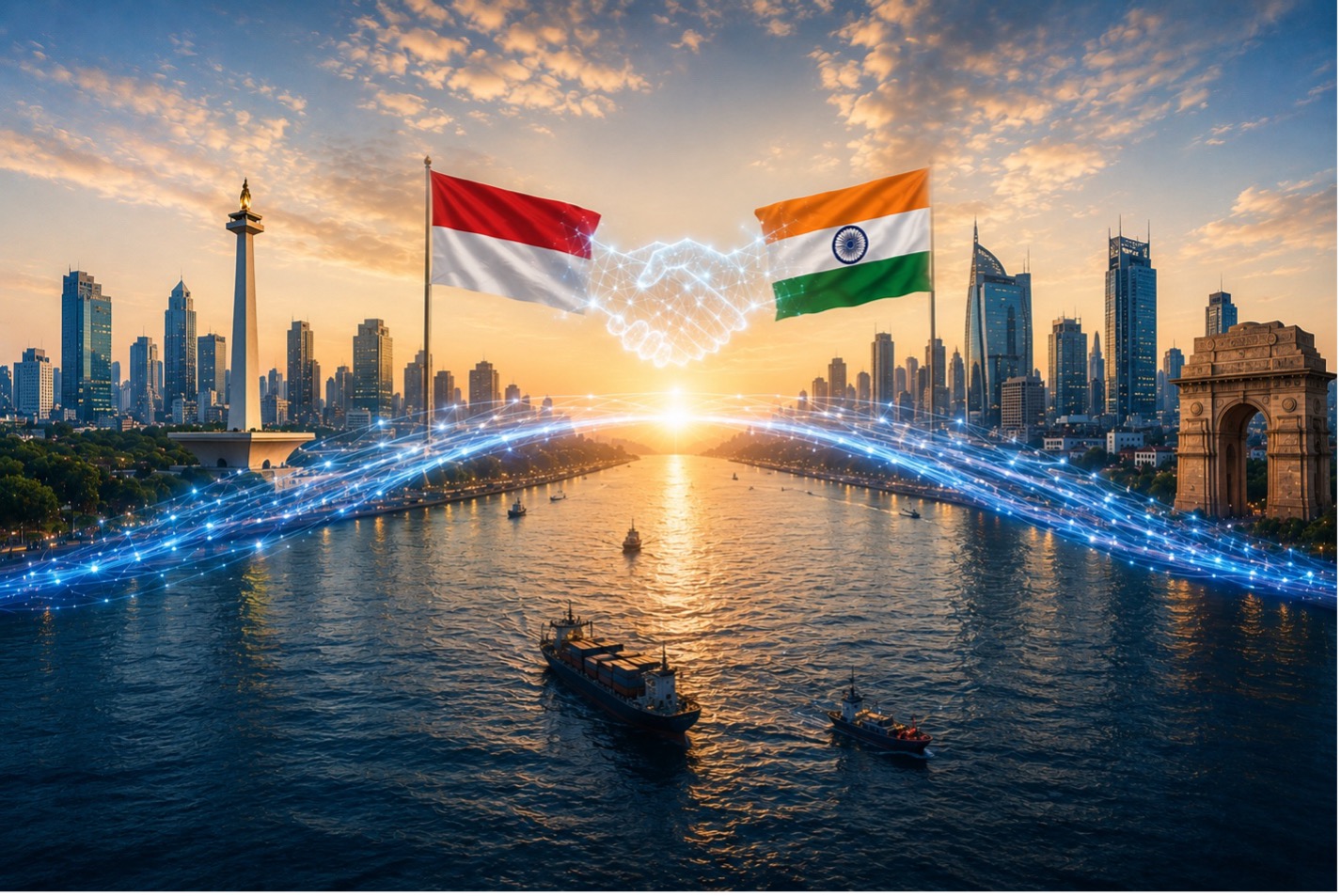
“For decades, India and Indonesia have been connected by geography, history, and culture. Today we have an opportunity to build a new bridge between our nations — a digital bridge that enables innovation, inclusion, and shared prosperity at unprecedented scale,” Ambassador Sandeep Chakravorty recently observed while discussing the growing importance of digital cooperation between the two countries. He has also argued that open digital networks could provide structural leverage for Indonesia to achieve its 8 percent growth ambition, by expanding markets for small businesses that remain productive but geographically and digitally constrained.
Indonesia today is undergoing what can best be described as a strategic recalibration. As the country seeks greater economic sovereignty and resilience, it is simultaneously strengthening relationships across multiple centers of global power. Europe is increasingly important for technology and critical minerals cooperation. The Middle East serves as a source of sovereign investment and food security partnerships. China remains central to manufacturing and industrial investment. The United States and Western partners continue to play important roles in market access and geopolitical balancing. India, meanwhile, is emerging as Indonesia’s preferred partner for Digital Public Infrastructure and population-scale technology collaboration.
This is not accidental. India has spent the last decade building what many now regard as the world’s most successful DPI ecosystem. Rather than relying on proprietary platforms and expensive technology stacks, India developed open digital rails that enabled innovation at scale. The results have been remarkable. Aadhaar, India’s biometric identity platform, has now surpassed 150 billion authentication transactions, providing digital identity to virtually the entire adult population. UPI, India’s real-time payments system, processed 17,221 crore transactions in 2024 — representing 83 percent of India’s total digital payments volume, at a compounded annual growth rate of 114 percent over the past seven years. The IMF has recognized UPI as the world’s largest retail fast-payment system by transaction volume, accounting for approximately 49 percent of all global real-time payment transactions. India has now signed DPI cooperation agreements with 23 countries, and UPI is live in eight of them, from Singapore to France.
Indonesia faces many of the same challenges India confronted a decade ago. How do you digitize a population spread across thousands of islands? How do you ensure small businesses can compete in a digital economy increasingly dominated by large platforms? How do you prevent digital dependence from becoming a new form of economic dependence? And how do you build technology systems that serve national interests rather than creating costly vendor lock-ins? These questions are now at the center of Indonesia’s digital transformation agenda. Indonesia today has over 200 million mobile internet users and a digital economy projected to reach USD 194.5 billion in e-commerce alone by 2030.
Perhaps the most visible example of the new India-Indonesia digital axis is the Indonesia Open Network (ION), which is expected to mark its first live transaction during Prime Minister Modi and President Prabowo’s joint summit. Inspired by the success of India’s Open Network for Digital Commerce (ONDC), ION is built on the Beckn 2.0 open protocol. Unlike traditional marketplaces, ION functions as a neutral digital rail connecting buyers, sellers, logistics providers, payment systems, and financial institutions across a shared, interoperable ecosystem. Its ambition is significant.
Today, many Indonesian MSMEs remain excluded from the full benefits of digital commerce. Platform commissions and fees frequently range between 25 and 40 percent of transaction value, creating barriers for small sellers, farmers, cooperatives, and rural entrepreneurs. As APINDO Chairman Shinta Kamdani has observed, “Indonesia’s next phase of economic growth will depend on ensuring that MSMEs are not merely consumers of technology but active participants in the digital economy.” ION seeks to reduce transaction costs to below 8 percent, in line with President Prabowo’s vision for a more inclusive digital economy. The objective is simple but powerful: allow anyone to sell anything, from anywhere, to anybody.
By making logistics interoperable, enabling embedded finance, connecting payment systems, and supporting village-level commerce ecosystems, ION aims to connect more than 30 million sellers to over 150 million buyers across Indonesia’s 38 provinces. T. Koshy, the former Managing Director of ONDC who now advises Indonesia’s digital commerce initiatives, stated, “Open networks succeed because they democratize opportunity rather than concentrating it.”
A second initiative is equally important. The integration of India’s UPI with Indonesia’s QRIS payment ecosystem has the potential to become one of the most consequential financial connectivity projects in Asia. QRIS has already demonstrated the transformative power of interoperable payments at scale: by the end of 2025, QRIS had reached 59 million users and 42 million merchants — surpassing its annual targets — processing 13.66 billion transactions across the year, compared to a target of 6.5 billion. QRIS Cross-Border is already operational in Thailand, Malaysia, Singapore, and Japan, and Bank Indonesia is actively exploring a formal integration with India’s UPI — a development that could unlock one of Asia’s most consequential payment corridors.
For destinations such as Bali, where Indian visitor numbers continue to grow rapidly, seamless cross-border payments could remove one of the last remaining friction points in the travel experience. More importantly, it would establish the foundation for a broader digital trade corridor between Southeast Asia’s largest economy and one of the world’s fastest-growing major markets. As Dr. Bayu Prawira Hie, a leading digital transformation expert, recently observed: “Interoperability is no longer a technical issue; it is an economic leverage issue.”
The third area of cooperation may prove even more strategic. India’s Protean e-Gov Technologies, one of the architects behind many of India’s foundational DPI layers — spanning digital identity, eKYC, eSignatures, tax modernization, pensions, and open digital commerce — is currently exploring opportunities to support Indonesia’s national DPI ambitions. The vision being discussed goes well beyond technology deployment. Indonesia’s National Economic Council, under the Digital Nusantara initiative, has articulated a goal of building a unified, interoperable, and scalable national digital infrastructure capable of supporting inclusive and sustainable development, including for social assistance delivery, government services, and MSME enablement.
Indonesia’s Ministry of Communications and Digital Affairs (Komdigi) has articulated ambitions to position Indonesia as a producer and exporter of digital solutions across ASEAN, not simply a consumer. “Indonesia must become not only a consumer of digital technologies but a producer of digital innovation” said Dr. Ilham Habibie, Chairman of the National ICT Council, who firmly believes that Indonesia’s long-term competitiveness will depend on developing sovereign digital capabilities rather than relying exclusively on imported platforms.
The fourth initiative addresses an area of increasing national importance: capital market modernization. Indonesia’s equity markets have recently faced heightened scrutiny over governance, transparency, and investor confidence. Discussions are underway involving Indian technology firms such as Remiges Technologies and institutions linked to the Bombay Stock Exchange ecosystem to explore AI-powered surveillance, market integrity solutions, and digital investment platforms. India modernized its capital markets through technology and automation three decades ago, and that experience has direct relevance for Indonesia today. According to Primus Dorimulu, CEO of InvestorTrust Media and DataTrust, “Indonesia’s capital markets are entering a new phase where technology-driven trust and transparency will become critical to attracting long-term participation from both domestic and international investors.”
Viewed individually, each of these initiatives may appear technical. Viewed collectively, they tell a larger story. The India–Indonesia relationship is evolving beyond trade and diplomacy into something more foundational: the co-creation of digital infrastructure capable of supporting economic growth, inclusion, and innovation at population scale.
If the twentieth century connected nations through shipping lanes and trade routes, the twenty-first century will increasingly connect them through digital rails. Prime Minister Modi’s visit arrives at precisely the moment when Indonesia is searching for new engines of growth, greater economic resilience, and more inclusive development. Digital Public Infrastructure may not generate the headlines of a major investment announcement. But its long-term impact — across commerce, finance, governance, and everyday economic life — could prove far greater.
And if the initiatives taking shape between Jakarta and New Delhi succeed, the digital bridge being built between the two capitals may become one of the most strategically significant assets in the future of both nations — and a model for the Global South.
About the Author

Sachin V. Gopalan is Founder and CEO of the Indonesia Economic Forum and Chairman of the ASEAN Economic Forum. He is leading the Indonesia Open Network (ION) initiative and writes regularly on digital public infrastructure, regional economic integration and emerging technologies.