
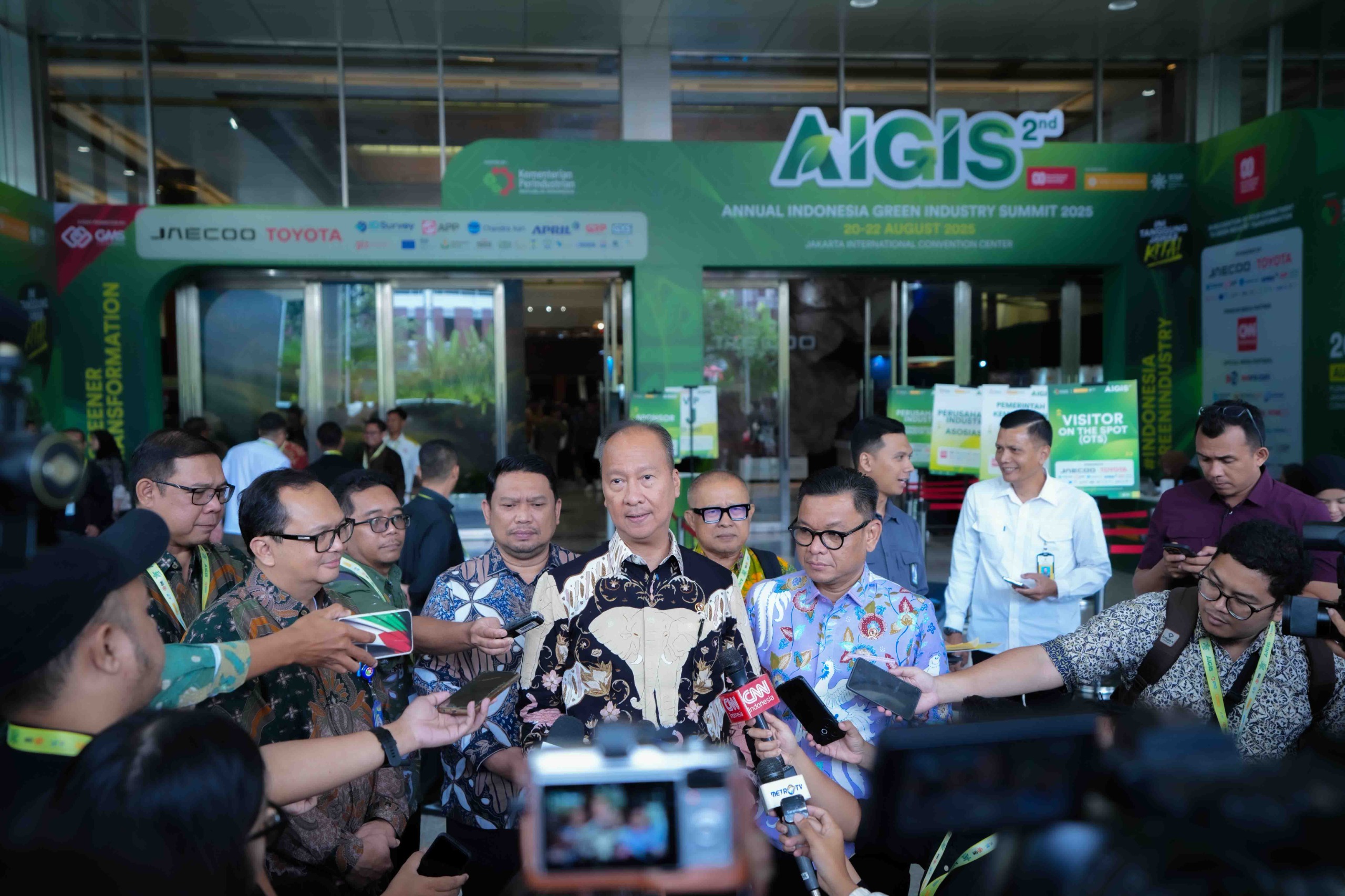

Jakarta, August 20, 2025 — The Ministry of Industry hosted the Annual Indonesia Green Industry Summit (AIGIS) 2025 at the Jakarta Convention Center (JCC) from August 20–22, 2025. This annual forum serves as a strategic platform to strengthen policies, innovations, and collaborations in advancing energy transition, industrial decarbonization, and the development of a globally competitive green industry ecosystem.
One of its key sessions was Green Talks Panel 1, with the theme “Synergy of Green Transition Policies and Carbon Economy for Realizing a Green Industry.” The discussion was moderated by Desi Anwar, Director and Senior News Anchor of CNN Indonesia, and featured three distinguished speakers:
- Apit Pria Nugraha, Head of the Center for Green Industry, Agency for Industrial Policy, Standardization, and Services (BKSJI), Ministry of Industry
- Ari Sudijanto, Deputy for Climate Change Control and Carbon Economic Value Governance, Ministry of Environment and Forestry (MoEF)
- Hendra Iswahyudi, Director of Energy Conservation, Directorate General of New, Renewable Energy and Energy Conservation (EBTKE), Ministry of Energy and Mineral Resources (MEMR)
Green Industry Roadmap and Decarbonization Challenges
Apit Pria Nugraha emphasized that the Ministry of Industry is targeting net zero emissions in 2050, a decade ahead of Indonesia’s national target of 2060.
“To achieve this, the Ministry has developed decarbonization roadmaps for nine key industrial subsectors, ranging from cement, fertilizer, metals, pulp and paper, to food and beverages,” he stressed.
Of these nine subsectors, four priority sectors — cement, fertilizer, pulp and paper, and metals — were selected as they contribute more than 60% of total industrial emissions. Future policy will focus on emission caps as the foundation for the implementation of a mandatory Emission Trading System (ETS) starting in 2027.
Apit underlined that emission reduction regulations must go hand in hand with maintaining industrial competitiveness. For this reason, the Ministry is preparing green financing schemes and promoting the Energy Service Company (ESCO) business model to support the transition to low-carbon technologies.
Carbon Economic Value as a Financing Instrument
Ari Sudijanto of the Ministry of Environment and Forestry highlighted the importance of carbon economic value as an instrument to support climate action financing. Presidential Regulation No. 98/2021 stipulates four schemes: result-based payment, carbon trading (ETS and offset), carbon levy, and other mechanisms.
According to Ari, carbon economic value functions as an incentive to make green projects, including in the industrial sector, more financially attractive. Indonesia has also established a cross-sectoral emissions inventory system that can be internationally verified, thereby strengthening market confidence in Indonesian carbon credits.
“Decarbonization is not merely an obligation, but an opportunity for Indonesian industry to become more competitive in the global market,” Ari stressed.
Energy Efficiency and Transition in the Energy Sector
Meanwhile, Hendra Iswahyudi from the Ministry of Energy and Mineral Resources underlined that energy efficiency is the first step toward energy transition. Large energy-consuming industries are required to implement energy management, conduct energy audits, and utilize equipment with high efficiency standards.
Hendra added:
“The Ministry of Energy and Mineral Resources promotes collaboration with banks and financial institutions through the green taxonomy of the Financial Services Authority (OJK) so that energy efficiency and transition projects receive financial support. In addition, carbon economic value can also be utilized by industries to gain additional revenue through carbon credit trading in both domestic and international markets.”
Synergy as the Key
The panel discussion reinforced that synergy between ministries, the business sector, and financial institutions is essential to achieving decarbonization targets. Integrating reporting systems, green financing schemes, and the adoption of low-carbon technologies are expected to accelerate the realization of a globally competitive green industry.
“Decarbonization must not be seen as a burden, but as an opportunity to build a more resilient and competitive industry in the international market,” concluded Desi Anwar in closing the session.
Through this discussion, AIGIS 2025 reaffirmed its position as the premier annual forum initiated by the Ministry of Industry to drive Indonesia’s green transformation. The first Green Talks panel demonstrated that with the right policies, financing support, and cross-sector synergy, Indonesia has the potential to become a regional pioneer in green industry development while making a meaningful contribution to global emission reduction targets.