
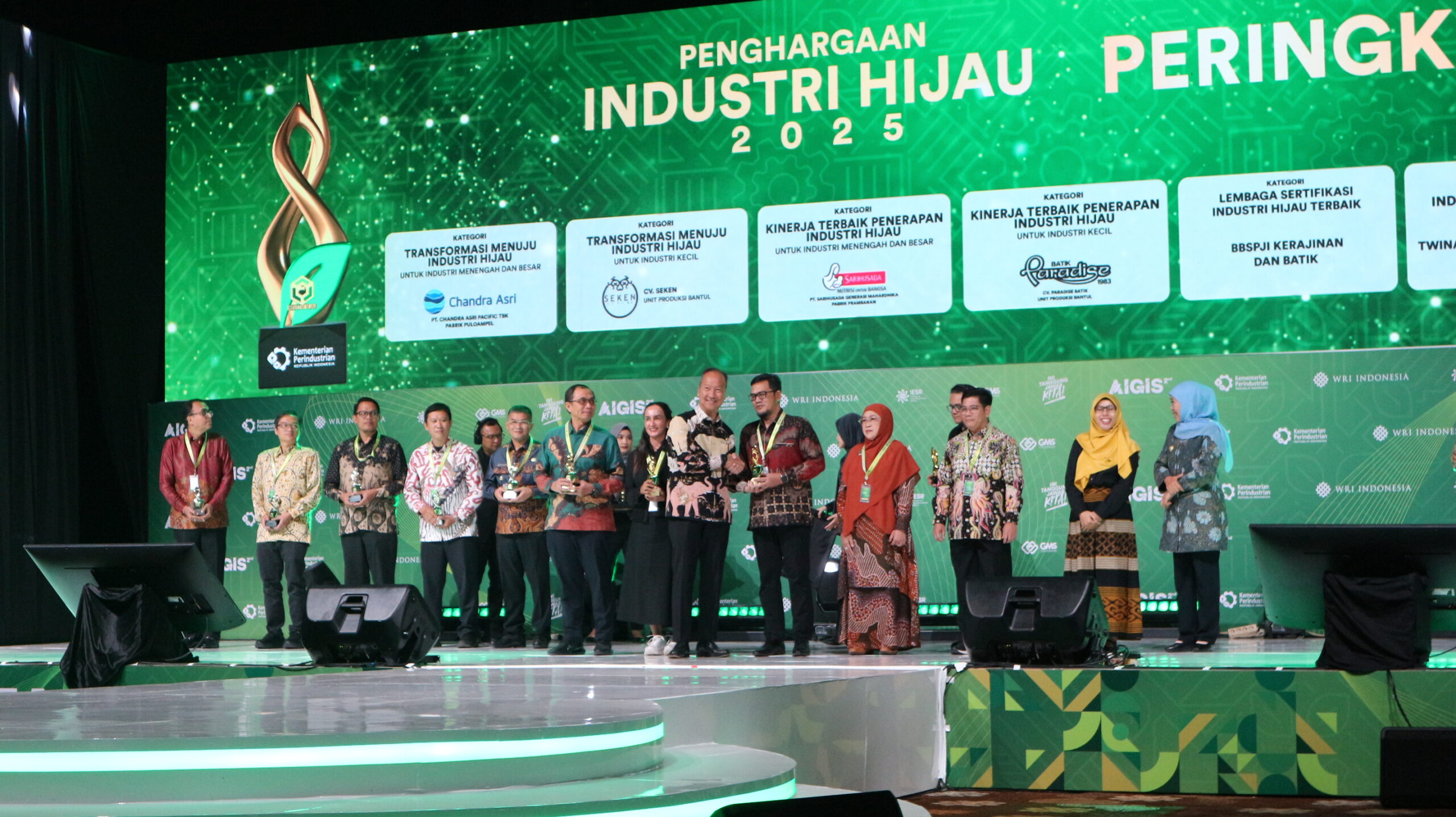

Jakarta, August 20, 2025 — The Ministry of Industry convened the Annual Indonesia Green Industry Summit (AIGIS) 2025 at the Jakarta Convention Center (JCC) from August 20–22, 2025. This forum serves as a strategic platform to strengthen the transformation of industry toward a green economy. Among the key sessions in the Green Talks series was Panel 2, themed “Building Synergy, Policies, and Financial Incentives for Green Investment.”
The discussion was moderated by Suzanty Sitorus, Executive Director of Viriya ENB, and featured four distinguished speakers:
- Roby Fadillah, Director of Industry, Trade, and Investment Enhancement, Ministry of National Development Planning (Bappenas)
- Rizky Aulia Rahman, Young Policy Analyst, Directorate General of Financial Sector Stability and Development, Ministry of Finance
- Kurniawan Agung, Head of Green Finance Group, Bank Indonesia
- Joko Siswanto, Head of the Directorate of Sustainable Finance, Financial Services Authority (OJK)
National Planning and Green Investment
Roby Fadillah explained that the Ministry of National Development Planning (Bappenas) has embedded the green transition as a priority in the National Long-Term Development Plan (RPJPN) 2025–2045. The focus, he emphasized, is not only on emission reductions but also on creating a conducive investment climate. According to him, the industrial sector requires policy certainty to attract investors to green projects.
“Green investment will deliver a dual contribution: driving economic growth while ensuring environmental sustainability,” Roby stated.
Fiscal Incentives for Acceleration
From the fiscal policy perspective, Rizky Aulia Rahman stressed that the Ministry of Finance is preparing various incentive instruments to accelerate green financing. These include tax incentives, support for energy transition financing, and the implementation of carbon economic value.
Rizky underscored that the success of decarbonization depends greatly on clear price signals, enabling low-carbon projects to compete with fossil energy. He further noted that collaboration with financial institutions is key to expanding access to green financing, particularly for energy-intensive industries.
The Central Bank’s Role in the Green Transition
Meanwhile, Kurniawan Agung of Bank Indonesia highlighted the importance of macroeconomic stability in supporting green investment. Bank Indonesia has developed green finance policies through monetary and macroprudential instruments, including support for the green taxonomy jointly designed with OJK.
Kurniawan explained that Bank Indonesia is encouraging the banking system to play a more active role in channeling credit toward green projects.
“We are not only maintaining stability, but also ensuring that the green transition becomes an integral part of the future architecture of monetary policy,” he remarked.
OJK and the Sustainable Finance Framework
On the regulatory side of the financial sector, Joko Siswanto emphasized that the Financial Services Authority (OJK) has prepared a sustainable finance framework to guide financial institutions, the capital market, and non-bank industries in supporting the green transition. OJK is strengthening the implementation of Indonesia’s Green Taxonomy as a reference for investors and businesses to identify credible green projects.
Joko added that OJK is also pushing to enhance the capacity of financial institutions so they are better prepared to assess climate risks and integrate them into investment decision-making processes.
Synergy of Policy and Finance
The discussion underscored that synergy among ministries, financial authorities, and the business community is a decisive factor for the success of green investment in Indonesia. With clear national planning, robust fiscal incentives, central bank support, and credible financial regulation, Indonesia is well positioned to accelerate its transition toward a low-carbon economy.
Through Green Talks Panel 2, AIGIS 2025 reaffirmed the importance of aligning policy and finance in building a green investment ecosystem. The forum demonstrated that the success of the green transition does not solely depend on technology, but also on a consistent policy framework, fiscal support, and investor confidence. With collective action, Indonesia holds significant potential to become a hub for green investment in the region.