
By Gurjit Singh, Former Ambassador to Indonesia and ASEAN and author of The Mango Flavour: India, ASEAN and the Act East Policy
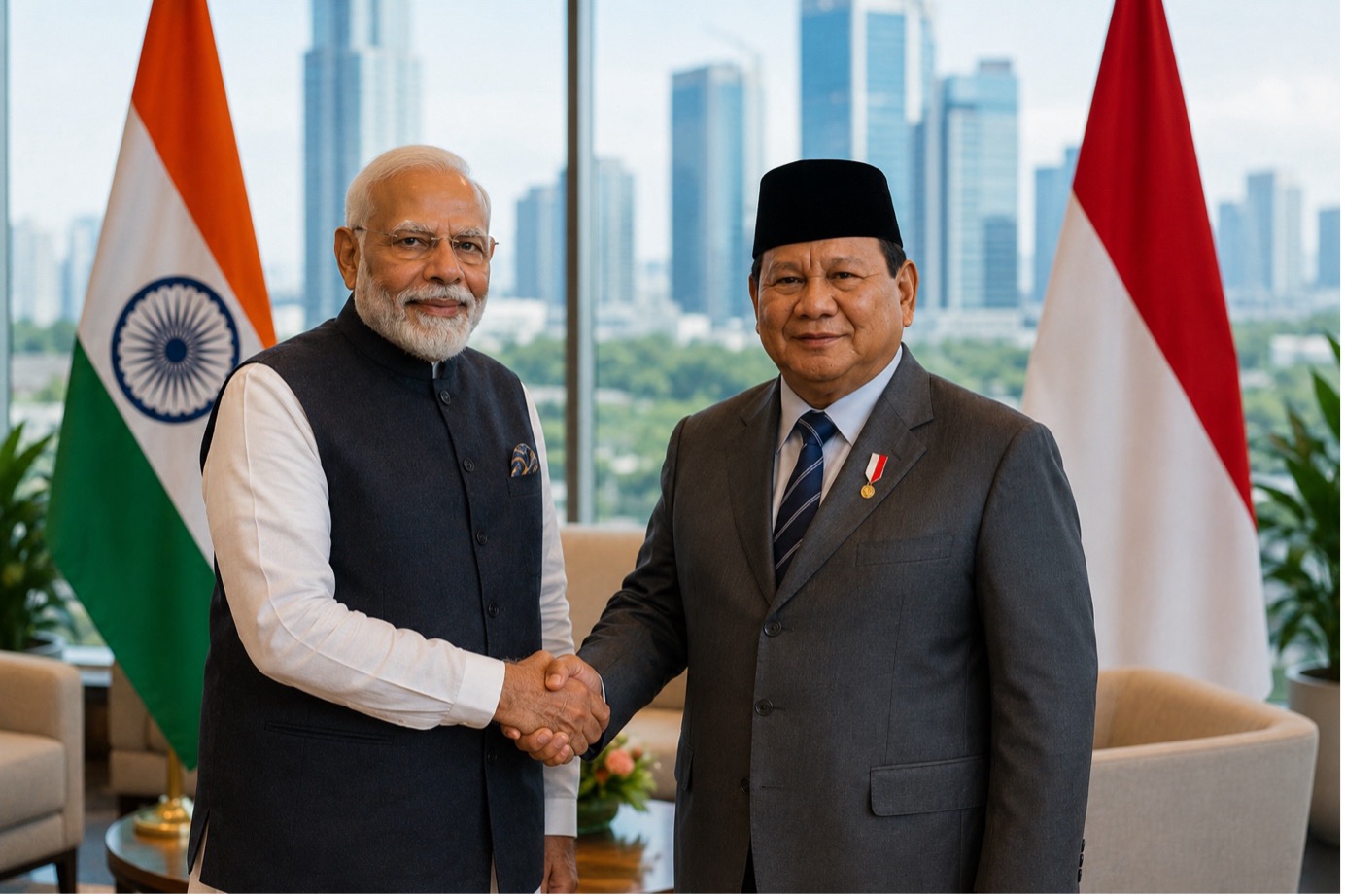
Prime Minister Modi’s expected visit to Indonesia offers an opportunity to elevate one of Asia’s most under-realized strategic partnerships. Despite being two large democracies, maritime powers, G20 members, and influential voices of the Global South, India and Indonesia have often underperformed relative to their potential. The visit could therefore become a turning point—but only if both sides move beyond symbolism and institutionalize cooperation in trade, technology, connectivity, maritime security, and people-to-people engagement.
From Strategic Partnership to Strategic Convergence
The relationship received significant momentum during Indonesian President Prabowo Subianto’s state visit to India in January 2025, which coincided with the 75th anniversary of diplomatic relations. Five agreements covering health, traditional medicine, digital cooperation, maritime security, and cultural exchanges reflected a broadening agenda. Prabowo’s role as Chief Guest at India’s Republic Day celebrations underscored Indonesia’s growing importance in India’s Indo-Pacific strategy.
Yet the broader question remains: can these outcomes produce a quantum leap?
The answer depends on whether both countries can transform a relationship traditionally driven by diplomatic goodwill into one anchored in economic and technological interdependence.
Survey of Earlier Outcomes
Historically, India and Indonesia have enjoyed strong civilizational links and political understanding. Cooperation during anti-colonial struggles, membership of the Bandung movement, and support for a multipolar international order created a durable foundation.
In recent years, positive developments include:
- Expansion of naval and maritime cooperation, including coordinated patrols and exercises.
- Growing defence engagement and interest in Indian defence equipment.
- Cultural and educational exchanges.
- Restoration and conservation support related to the Prambanan temple complex.
- Increased Indian investment in Indonesia.
- Exploration of cross-currency trade mechanisms.
- Cooperation between the Indian Coast Guard and Indonesia’s BAKAMLA.
However, despite these advances, trade remains well below potential and Indian investment lags behind that of China, Japan, South Korea and Singapore. The relationship has often been described as strategically important but economically underdeveloped.
Why the Timing is Different
Several structural developments make the present moment unusually favourable.
Global South Leadership
Both countries increasingly see themselves as leaders of the Global South. As major developing economies, they share concerns regarding reform of global governance institutions, climate financing, development funding, food security, and technological access.
At a time when globalization faces headwinds from geopolitical rivalry, supply-chain fragmentation and protectionism, India and Indonesia can jointly advocate for a more inclusive economic order.
Unlike many Global South partnerships that remain rhetorical, India and Indonesia possess the economic scale and diplomatic influence to shape outcomes in forums such as the G20, BRICS and ASEAN.
Food and Energy Security
Both countries face vulnerabilities arising from food inflation, energy price fluctuations and climate change.
Indonesia is a critical producer of commodities including palm oil, nickel and coal, while India represents a massive consumer market. Joint investments in food processing, fertilizers, renewable energy, biofuels and strategic reserves could provide mutual resilience.
Food and energy security may emerge as one of the strongest pillars of future cooperation because they are driven by long-term structural interests rather than short-term political considerations.
Maritime Security and Defence Production
The maritime dimension offers perhaps the most strategic opportunity.
Located astride the approaches to the Straits of Malacca, Lombok and Sunda, Indonesia occupies a pivotal position in Indo-Pacific geopolitics. India, meanwhile, seeks greater maritime engagement to the east under its Act East and Indo-Pacific policies.
Shared concerns include:
- Freedom of navigation.
- Maritime domain awareness.
- Illegal fishing.
- Piracy and transnational crime.
- Supply-chain security.
- Disaster response.
The next stage should move beyond exercises toward defence-industrial collaboration, maintenance facilities, joint production and technology transfer. Indonesia’s desire to diversify defence suppliers creates openings for Indian platforms and systems.
Digital Partnership: A Potential Game Changer
Perhaps the most promising new area is digital cooperation.
The launch of the Indonesia Open Network (ION), inspired by India’s Open Network for Digital Commerce (ONDC), represents a significant transfer of digital public infrastructure expertise.
India’s success with digital public goods—from identity systems to payment infrastructure—has attracted global interest. Indonesia’s large digital economy makes it an ideal partner for adapting these innovations.
The emerging agenda could include:
- Digital public infrastructure.
- Artificial intelligence.
- Cybersecurity.
- Fintech.
- MSME digitalization.
- Digital skills development.
In a world increasingly shaped by technology competition, a successful India-Indonesia digital partnership could become a model for the Global South.
Persistent Obstacles
Despite optimism, several constraints continue to impede progress.
Knowledge Deficit
Perhaps the greatest challenge is the astonishing lack of mutual awareness.
Indian businesses often understand Indonesia far less than they understand Europe, North America or even the Gulf. Likewise, many Indonesians have limited exposure to contemporary India beyond historical and cultural associations.
Institutions dedicated to sustained intellectual exchange remain inadequate. New bridging institutions, think-tank networks and academic partnerships are urgently needed.
Perception Issues
A recurring concern among Indonesian stakeholders is the perception that some Indians approach the relationship from a “civilizational seniority” perspective, emphasizing historical Indian influence on Indonesian culture.
Such narratives can inadvertently create resentment. Modern Indonesia is a proud, sovereign nation whose achievements are distinctly Indonesian. Future engagement must emphasize partnership among equals rather than cultural inheritance.
Weak Business Ecosystem Support
Indian companies frequently report difficulty navigating Indonesia’s political and regulatory landscape. Japanese and Chinese firms often demonstrate greater local understanding, stronger networks and more sustained engagement.
Concerns include:
- Slow administrative processes.
- Limited business facilitation.
- Government procurement barriers.
- OECD-related tender provisions in some sectors.
- Inadequate market intelligence.
There is also criticism that India’s diplomatic and commercial outreach infrastructure remains under-resourced compared to competitors.
Human Mobility Constraints
Business engagement remains concentrated at CEO and senior management levels.
There is insufficient movement of professionals, researchers, students, start-ups and skilled workers. Greater mobility would deepen familiarity and create constituencies for the relationship.
Absence of Flagship Projects
One striking weakness is the lack of highly visible, transformative projects.
China has infrastructure. Japan has industrial parks. South Korea has manufacturing ecosystems.
India needs comparable flagship initiatives such as:
- Technology parks.
- Healthcare centres of excellence.
- Joint AI laboratories.
- University partnerships.
- IIT-style educational collaborations.
- Pharmaceutical manufacturing hubs.
Without visible successes, public perceptions will lag behind diplomatic rhetoric.
Can Modi’s Visit Deliver a Quantum Leap?
A quantum leap is possible but not guaranteed.
Success will require moving from a relationship based primarily on strategic goodwill to one grounded in measurable outcomes. Three priorities stand out:
First, establish a comprehensive India-Indonesia technology and digital partnership centered on AI, digital public infrastructure and innovation.
Second, create flagship projects in health, education and technology that visibly improve lives and demonstrate India’s commitment.
Third, deepen maritime and defence-industrial cooperation to make the partnership a pillar of Indo-Pacific stability.
Conclusion
India and Indonesia today possess a rare convergence of interests: leadership of the Global South, maritime security concerns, food and energy resilience needs, and aspirations to shape emerging technologies. President Prabowo’s successful 2025 visit created momentum. Prime Minister Modi’s forthcoming visit offers the chance to convert that momentum into strategic transformation.
Whether the relationship takes a quantum leap will depend less on new declarations than on implementation. If both sides can overcome knowledge gaps, bureaucratic inertia and mutual misperceptions while delivering flagship initiatives, the India-Indonesia partnership could emerge as one of the most consequential bilateral relationships in the Indo-Pacific and a model of practical Global South cooperation in the coming decade.
About the Author

Ambassador Gurjit Singh is a former Ambassador of India to Indonesia, Timor-Leste and ASEAN. A distinguished diplomat and author, he is a leading commentator on Indo-Pacific affairs, India’s foreign policy and regional strategic cooperation.


