By SACHIN V. GOPALAN
Every economy, at some point in its journey, arrives at a question larger than growth rates, startup valuations, or technological breakthroughs. The question is not simply how fast innovation is moving. It is how the system itself is designed.
Indonesia may be reaching that moment now.
Over the past decade, the country has built one of Southeast Asia’s most dynamic digital economies. According to the latest e-Conomy SEA report by Google, Temasek, and Bain, Indonesia’s digital economy is projected to approach US$99 billion in gross merchandise value (GMV), making it the largest digital market in Southeast Asia. Much of that growth continues to be driven by e-commerce and digital services embedded in everyday life.
Behind that number lies a broader social transformation.
Millions of consumers now rely on digital platforms as part of their daily routines. Small businesses have entered online marketplaces. Digital payments have become second nature. From ordering meals and purchasing household items to paying bills and arranging transportation, economic activity increasingly happens through a smartphone screen.
On paper, this looks like a remarkable success story.
But success often reveals new questions.
As digital ecosystems mature, some structural challenges become harder to ignore. Why do small businesses often have to manage multiple platforms at once? Why do transaction and intermediation costs continue to weigh on sellers? Why does access to customers and data remain tied to closed systems?
These are not signs of failed innovation.
If anything, they may be symptoms of an architecture that was never originally designed to support participation at national scale. The challenge today is not simply digitization. It is coordination.
Public Infrastructure Is Not Always Physical
When people think of infrastructure, they usually think of roads, ports, bridges, or electricity grids.
Infrastructure exists because economies function better when foundational systems are shared. No single company owns an entire highway network. Public infrastructure enables participation
In recent years, that same idea has started expanding into the digital world through what is known as Digital Public Infrastructure, or DPI.
At its core, DPI refers to foundational digital systems that are open, interoperable, and accessible. Identity systems, payment rails, and secure data frameworks are some of the most common examples.
Indonesia already offers a compelling example of what this can look like.
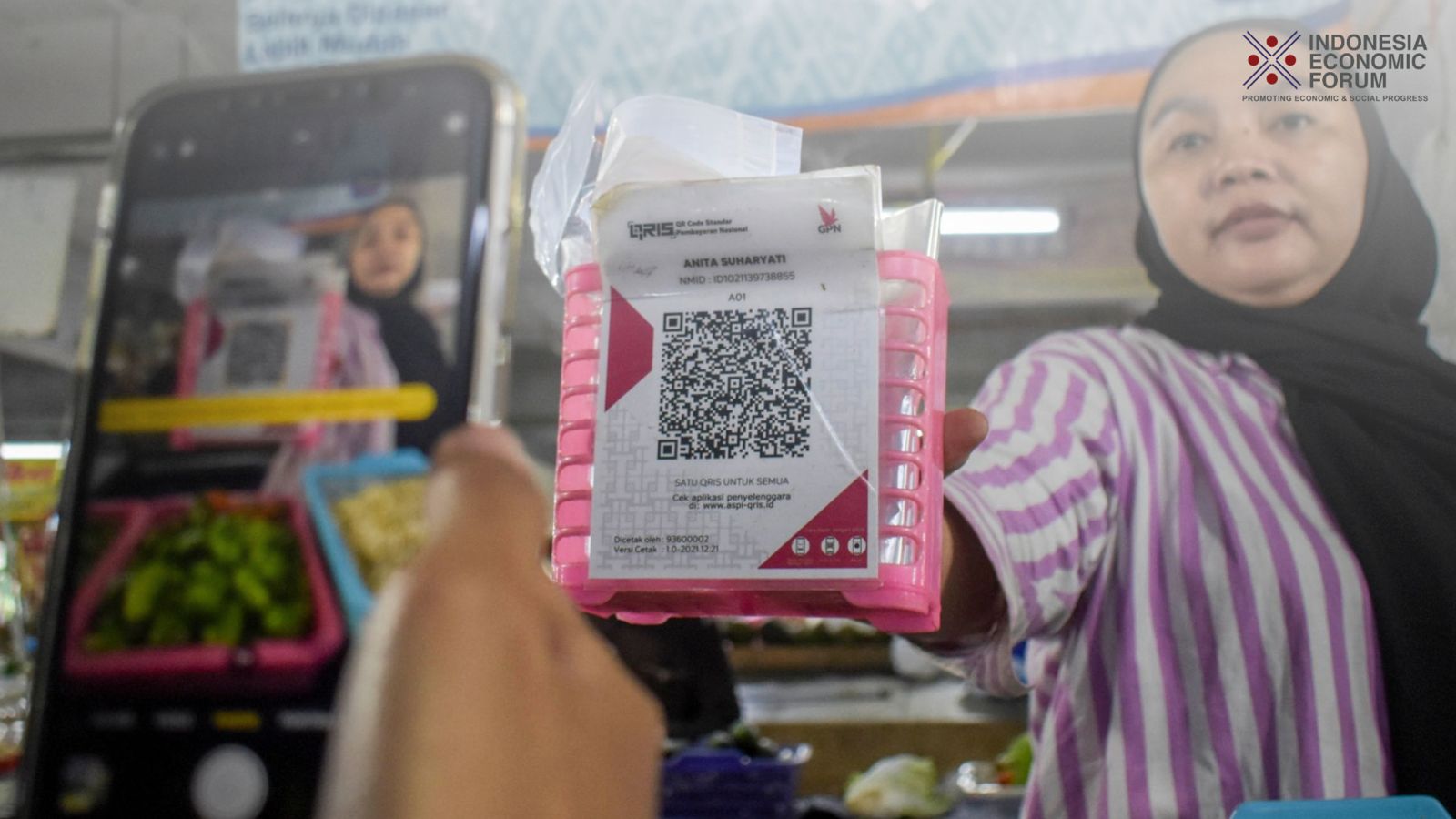
The success of QRIS demonstrated that interoperability is not merely a technical principle. It changed how merchants and consumers transact because it reduced friction. Rather than forcing users into separate payment silos, it created a system where different participants could connect.
That raises a larger question:
What if the same principle could be applied to commerce itself?
The Next Challenge Is Not Growth, It Is Complexity
Imagine a small business owner in Bandung, Surabaya, or Makassar trying to expand online.
Today, many merchants list products across multiple platforms, upload the same catalog repeatedly, manage separate inventories, coordinate with different logistics systems, and navigate multiple payment channels.
For many MSMEs, the challenge is no longer creating products.
The challenge is managing complexity.
This matters because MSMEs remain the backbone of Indonesia’s economy, accounting for the overwhelming majority of businesses and employment nationwide. Yet digital participation often comes with hidden operational costs: duplicated effort, fragmented systems, and dependency on platform-specific ecosystems.
Now imagine a different model.
A seller uploads products once and becomes visible across multiple buyer platforms. A logistics provider seamlessly serves orders from different applications.
Payments move through interoperable systems with minimal friction.
Data flows securely while giving participants more control rather than locking them into isolated ecosystems.
In this model, infrastructure does not exist to compete.
It exists to connect.
Moving From Control Toward Participation
The benefits may appear immediate.
For MSMEs, lower operational costs and less duplication.
For consumers, greater choice and healthier competition.
For the broader ecosystem, more efficiency and more room for innovation. But perhaps the most important impact is less visible.
It changes the balance of the digital economy itself.
From closed systems to open networks.
From fragmentation to cohesion.
From control to participation.
Indonesia has already shown that scale is not the problem. The country’s digital economy continues to grow at double-digit rates, and e-commerce alone contributes more than 70 percent of the total digital economy value.
The question, then, is not whether Indonesia has the capability.
It is whether Indonesia has the intention.
Because building digital public infrastructure for commerce is not simply a technical decision. It is a strategic choice about the shape of the future economy.
More importantly, it is a choice about who gets to participate in it.
Sachin V Gopalan is the CEO of Indonesia Economic Forum which is the Incubating Agency of Indonesia Open Network (ION) being launched in July 2026. He is also Head of Steering Committee of ION, which is as a model for open, interoperable digital commerce infrastructure in Indonesia and Southeast Asia.