

by Satish Chandra Mishra, Founder, The Arthashastra Institute Indonesia
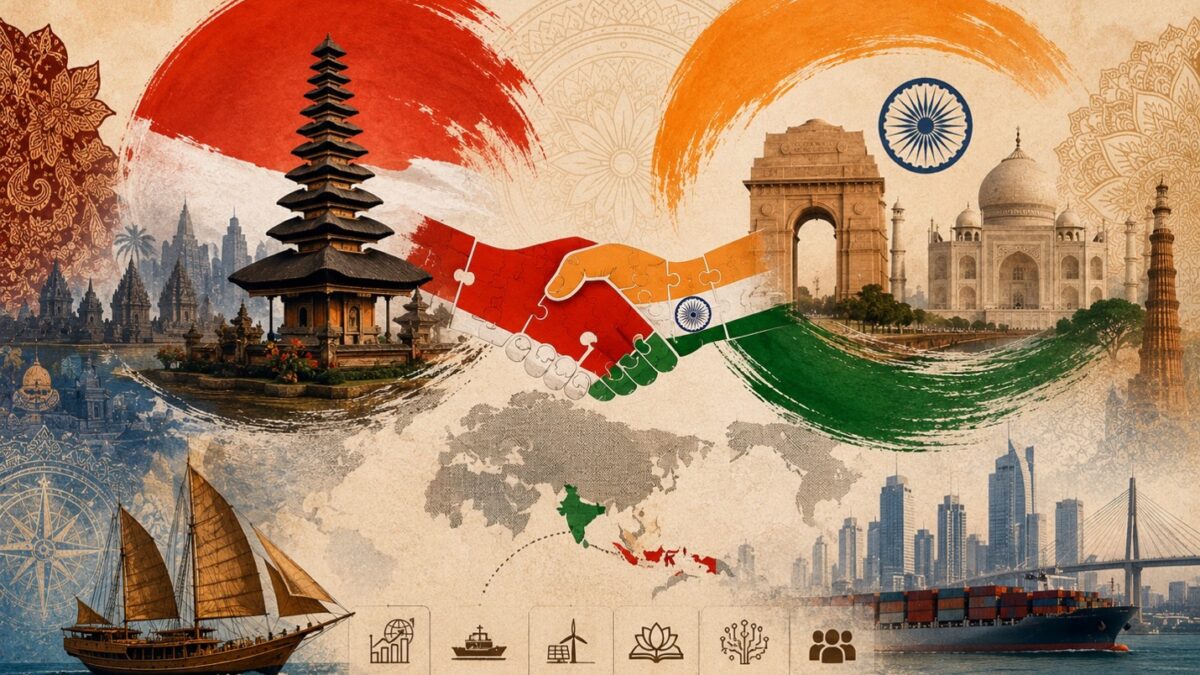
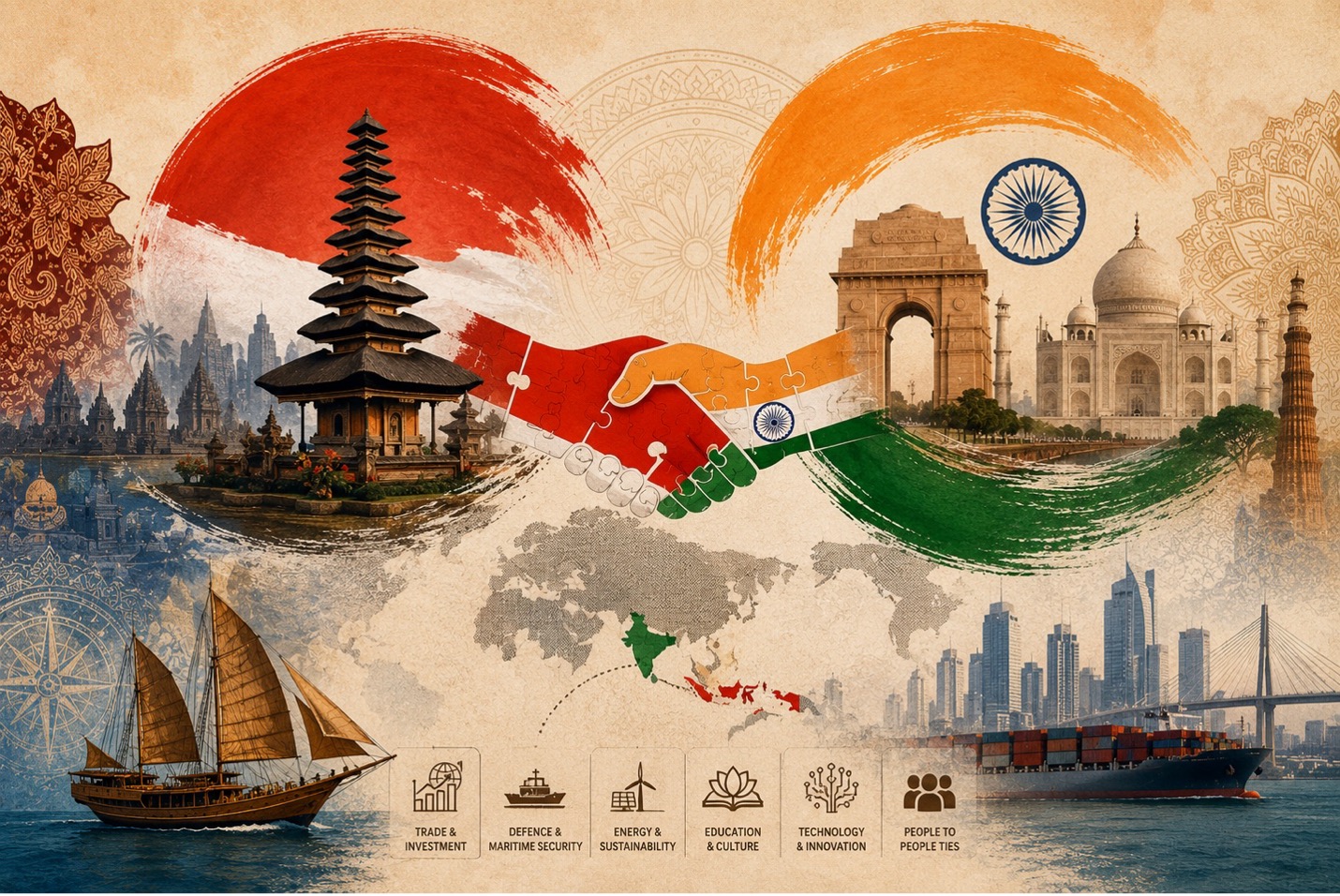
When Prime Minister Manmohan Singh and President Susilo Bambang Yudhoyono elevated bilateral ties to a Strategic Partnership in 2005, they were doing more than signing a framework document. They were reaching back across centuries to announce that India and Indonesia are not merely neighbors by geography but relatives by history. The phrase “civilizational diplomacy” has since resonated in both Jakarta and New Delhi, especially following President Prabowo Subianto visit for India’s Republic Day on January 26, 2025 where he declared that he also has ‘Indian DNA’. It signals engagement that draws not only on physical territory but on civilizational affinity, popular recognition and strategic relevance. What is interesting is that such common historical linguistic and cultural roots are being increasingly rediscovered , as in the accounts of the Sriwijaya empire, and emphasized by both Indonesia and India today.
The reasons are well known. For over two millennia, the Indonesian archipelago and the Indian subcontinent were bound together by the monsoon trade system, a time-honored seasonal engine of maritime commerce that carried not only spices and cloth but ideas, inventions, scripts, religions, political philosophies and court cultures across the Bay of Bengal. The Hindu-Buddhist kingdoms of Srivijaya, Majapahit and Mataram drew deeply from Brahminic and later Buddhist traditions originating on the subcontinent. Place-names across Java and Sumatra bear Sanskrit roots. Bali today remains a living museum of a pre-Islamic, India-centered civilization. The Ramayana and Mahabharata are not foreign imports in Indonesia; they are woven into an indigenous, shared cultural fabric.
Yet, such affinity alone is not enough. Post-independence India’s foreign policy was dominated by its immediate subcontinental neighborhood and its Cold War choices. Indonesia, under the New Order, was absorbed by political consolidation and ASEAN integration. The Bandung spirit of 1955, celebrated at the Asian-African Conference, signaled a sense of common purpose and close rapport between Soekarno and Nehru. It gave a much needed impetus to the decolonization spirit and its promise of agency and a role in global affairs for both India and Indonesia. Regrettably, the momentum of Bandung receded in the rough and tumble of post-independence political and economic reconstruction.
The twenty-first century has brought significant change to this post Bandung lethargy, driven by a convergence of numerous structural pressures. The first is economic. India’s rise after the 1991 reforms created a commercial search for deeper engagement with ASEAN’s largest economy. Bilateral trade, a modest USD 3.5 billion in 2004, rose to about USD 38 billion by 2022 before moderating to USD 29 billion, more a reflection of commodity cycles than systemic decline. The complementarity is genuine: Indonesia exports coal, palm oil and nickel for which Indian demand is rising, while India supplies pharmaceuticals, machinery, refined petroleum, IT services and textiles. The most significant new frontier is the electric-vehicle and battery supply chain: Indonesia holds the world’s largest nickel reserves, and India’s EV ambitions form a near-perfect counterpart.
Second, the Indo-Pacific has created a strategic logic for convergence independent of who governs in either capital. Both share a deep interest in a rules-based order, freedom of navigation and the preservation of ASEAN centrality. Both articulate a vision of the Indo-Pacific as “free, open and inclusive”. Jakarta’s preference for strategic autonomy, what Delhi calls multi-alignment, means both share a common desire for independent action in an evolving multipolar world. Civilizational diplomacy provides precisely this: a vocabulary that is neither aligned nor confrontational, rooted in their self-understanding as ancient polities with independent strategic traditions.
The third force is defence. From almost no meaningful defence contact before 2001, the two countries have built a structure of naval exercises, intelligence exchange and defence-industrial cooperation. Coordinated maritime patrols with the TNI-AL have run since 2012, expanding to anti-submarine exercises, and India’s BrahMos cruise missile has drawn keen Indonesian interest.
Striking, too, is the consistency of Indonesian commitment across three different presidencies. It was Yudhoyono who first elevated the relationship in 2005. It was Joko Widodo who, with Narendra Modi, gave it institutional weight through the 2018 Comprehensive Strategic Partnership. Prabowo Subianto, following his 2025 India visit, carries that momentum forward, broadening it toward defence financing and food security. Across different coalitions, this continuous stream of interest has made civilizational diplomacy a settled national orientation rather than the enthusiasm of any single administration.
The strategic environment of 2025 reinforces the logic. The post-Cold War liberal order, confident of globalization and a stable security umbrella, has given way to a contested, multipolar and transactional world. The retreat of globalization gives middle powers powerful incentives to diversify and reduce dependence on any single great power. Indonesia’s downstream processing and India’s positioning as a manufacturing alternative make each a natural hedge for the other.
There is a normative dimension too. India is the world’s largest democracy and Indonesia the third largest, and the largest Muslim-majority democracy. Together they are home to more than 1.75 billion people, over a fifth of humanity and a number already close to that of every other democracy on earth combined. And the balance is tilting their way: as much of the democratic world ages or shrinks while these two keep growing, by 2040, barring a fresh wave of democratization, India and Indonesia alone may outnumber all other democracies combined.
Here their national ambitions converge most strikingly. India has framed its future around Viksit Bharat 2047, the aspiration to become a developed nation by the centenary of its independence; Indonesia around Indonesia Emas 2045, the “Golden Indonesia” it means to be by the hundredth year of its own. Set two years apart, both rest on the same wager: that a young workforce can be turned into prosperity before that window closes. Each faces the same race against an aging future, and each now has a partner with every reason to want the other to succeed.
None of this is automatic. Civilizational sentiment will mean little unless institutional architecture deepens beyond episodic summitry, complementarities translate into investment flows, and people-to-people ties, through students, tourists and diaspora, give the inheritance everyday content.
History, culture and trust are the foundation; commerce the motor; defence the strategic map; and democracy the framework of concepts and values. As the Indo-Pacific becomes the crucible of twenty-first-century geopolitics, in which the world’s largest democracy and the largest Muslim-majority democracy steadily build a defining relationship to last through the ages . It is an idea whose time has finally, and irreversibly, come.
About the Author
Dr. Satish Chandra Mishra is Founder of the Arthashastra Institute and a scholar of India–Indonesia civilizational relations. He writes extensively on strategic affairs, economic diplomacy and the evolving partnership between the two countries The Arthashastra Institute Indonesia is a non-profit organization dedicated to deepening historical linkages and strategic partnership between India, Indonesia and South East Asia. The views expressed here are personal.