
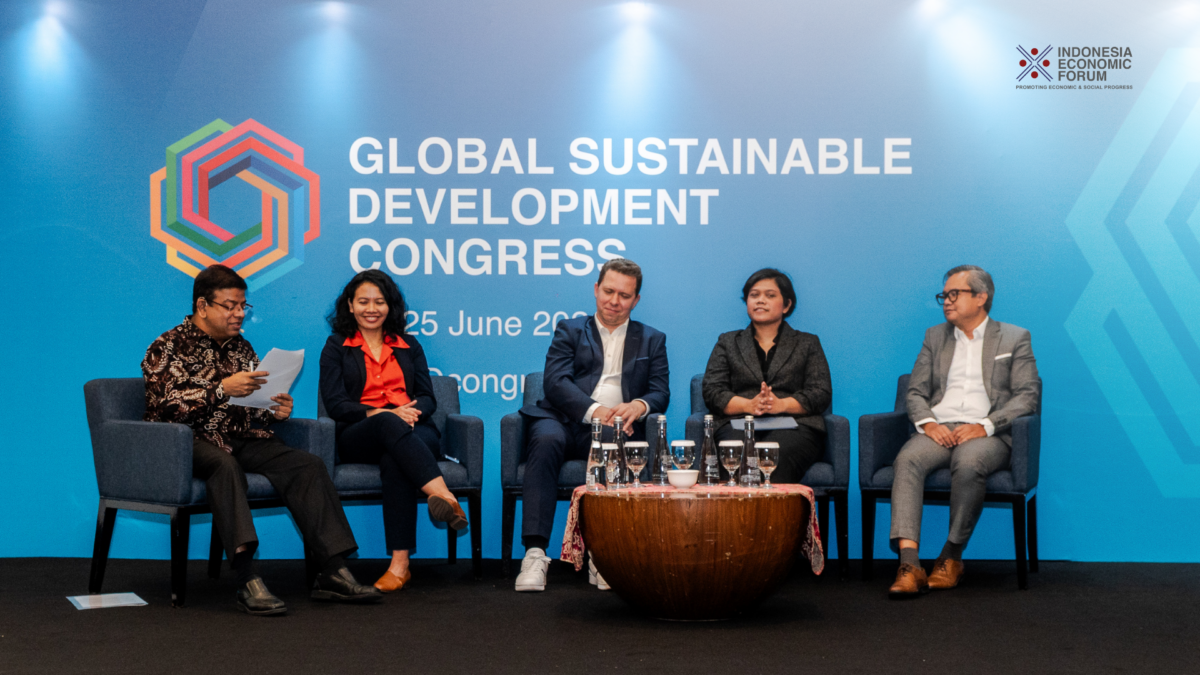

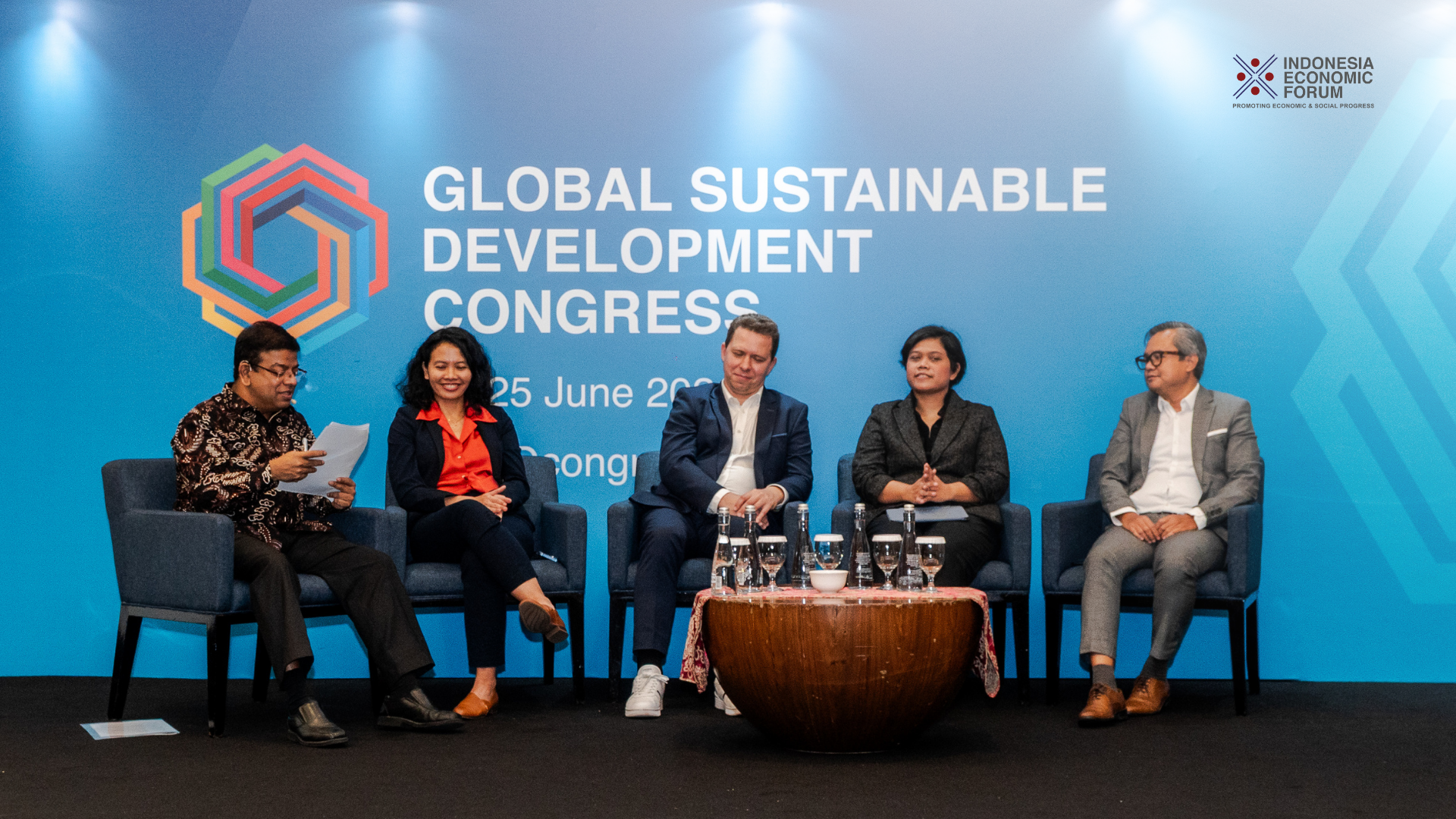
Tangerang, Indonesia — Addressing persistent capital gaps and strengthening collaboration between governments, investors and development institutions will be critical to accelerating sustainable growth across Southeast Asia, speakers said during a panel discussion at the Global Sustainable Development Congress (GSDC) 2026 held at ICE BSD, Tangerang, on Tuesday (23/6/2026).
Moderating the session, Indonesia Economic Forum Chief Executive Officer, Sachin Vijaya Gopalan said shifting geopolitical dynamics and evolving development priorities have made it increasingly important for stakeholders to align their approaches to sustainable finance and long-term economic development.
Gopalan framed the discussion around what he described as persistent capital gaps that continue to slow the flow of financing into sustainable infrastructure and development projects, despite growing commitments from governments, development finance institutions and private investors.
“We need to have a conversation, we need to have a discussion, so that we can find new ways forward,” Gopalan said, emphasizing the importance of aligning priorities and identifying solutions that can accelerate investment into sustainable growth initiatives.
The session, titled “Financing the Foundations of Sustainable Growth in Asia-Pacific”, brought together government officials, investment promotion leaders and financial inclusion experts to discuss how investment strategies and financing mechanisms can better support infrastructure development, economic resilience and inclusive growth across the region.
Governments Cannot Finance Development Alone
Leuserina Siagian, Head of the Investment and Integrated One Stop Services Unit of the Jakarta Provincial Government, said governments cannot shoulder the burden of financing large-scale infrastructure development on their own.
She pointed to Jakarta’s efforts to continue developing sustainable infrastructure while facing fiscal limitations, highlighting the importance of attracting private sector participation and strategic partnerships.
“We cannot just let the government stand alone. We must invite collaborators as well, like private investors and other strategic partners, to collaborate in projects,” she said.
According to Siagian, Jakarta remains an attractive investment destination despite the relocation of Indonesia’s national capital to Nusantara. She noted that the city continues to promote infrastructure and sustainability projects while encouraging both domestic and foreign investment.
The city is also prioritizing cleaner transportation systems, including the expansion of MRT and LRT networks and the transition of TransJakarta buses to electric vehicles.
“We need to deploy around 10,000 EV buses by 2030. It’s a big number and requires significant capital, but we continue inviting investors to participate because reducing air pollution will improve the quality of life for citizens,” she said.
Making Sustainable Projects Investable
Huda Albana, Investment Director for Southeast Asia at the Victorian Government Trade and Investment office, argued that policy certainty remains one of the most important factors influencing investment decisions.
She said long-term government commitments, particularly around climate and sustainability targets, help provide confidence for investors considering projects with extended payback periods.
Victoria, Australia, has established legally backed emissions reduction targets, including a net-zero goal by 2050, creating greater certainty for investors in renewable energy and sustainable infrastructure projects.
“What makes something investable is government policy certainty,” Albana said.
She also emphasized that governments have an important role in reducing risks associated with sustainable investments.
“The role of public money is to reduce risk, not create profit, but to allow private capital to scale and invest,” she said.
Albana highlighted how government-backed renewable energy procurement mechanisms can help make projects bankable, providing investors with the confidence needed to commit long-term capital.
She added that infrastructure investments must also be accompanied by investments in education, skills development and institutional capacity to ensure projects generate long-term productivity gains.
Expanding Access to Finance for Women and Small Businesses
Vitasari Anggraeni, Director of Policy for Southeast Asia at Women’s World Banking, stressed that sustainable growth cannot be achieved without addressing barriers faced by women entrepreneurs and underserved communities.
She noted that discussions around financial inclusion have evolved beyond simply providing access to financial services.
“When we talk about financial inclusion, it is not only about access. We also talk about financial wellbeing and financial health,” she said.
Women’s World Banking works with financial institutions, regulators and governments across Southeast Asia to improve access to finance for low-income women and women-owned businesses.
According to Anggraeni, one of the biggest challenges is not necessarily the availability of capital, but whether financing products are designed in ways that effectively meet the needs of intended beneficiaries.
She argued that policymakers and financial institutions must make better use of available data to understand how financing programs are performing and whether they are generating meaningful economic outcomes.
“The data is available, but sometimes it is not used to inform policy, design or investment decisions,” she said.
Anggraeni also highlighted the importance of improving coordination among institutions supporting micro and small enterprises, noting that fragmented initiatives often limit the impact of development programs.
Building Trust for Long-Term Investment
Cezary Filipek, Head of the Polish Investment and Trade Agency (PAIH) in Indonesia, emphasized that investor confidence and trust remain fundamental to sustainable development financing.
Drawing on Poland’s economic transformation over the past three decades, Filipek said long-term success depends not only on capital availability but also on stable institutions, reliable policies and strong partnerships.
“There has to be trust. The investor must have confidence that the system is stable and policies are not changing frequently,” he said.
Filipek also highlighted transportation infrastructure as a key area for sustainable investment, pointing to its role in reducing pollution, improving mobility and expanding economic opportunities.
He praised Indonesia’s recent progress in urban transportation development while noting that significant opportunities remain for future investment.
Aligning Priorities for Sustainable Growth
As the discussion concluded, panelists agreed that sustainable growth across Southeast Asia will depend on stronger cooperation between governments, investors, development institutions and communities.
Throughout the session, Gopalan repeatedly returned to the need for alignment between policy priorities, infrastructure development and investment strategies, arguing that sustainable development requires more than capital alone.
The panel’s final message was clear: financing sustainable growth is not simply about mobilizing money, but about creating the conditions that allow capital to flow into projects that generate long-term economic, social and environmental value.
As Filipek summarized, “Sustainable growth is not just about finance and money, but also confidence, value and trust.”