


JAKARTA, Indonesia Economic Forum — Indonesia’s debate over the proposed procurement of commercial vehicles from Indian manufacturers Tata Motors and Mahindra has triggered strong reactions from segments of the domestic automotive industry. Critics argue that importing vehicles threatens local manufacturing. However, the larger question facing Indonesia is whether maintaining the current structure of the automotive sector truly serves the country’s long-term economic interests.
For more than five decades, Indonesia’s automotive industry has been dominated by Japanese manufacturers such as Toyota, Daihatsu, Mitsubishi, Honda, Suzuki, and Isuzu. These companies operate through joint ventures with Indonesian conglomerates and have built extensive assembly plants, supplier networks, and distribution systems. While this ecosystem has contributed to industrial growth, it has also created a highly concentrated market where competition is limited and vehicle prices remain relatively high compared with other emerging markets.
Introducing vehicles from Indian manufacturers should therefore be viewed not as a threat, but as an opportunity to inject competition into a market long dominated by a single industrial ecosystem.
Indian companies such as Tata Motors and Mahindra specialize in producing rugged, affordable vehicles designed for emerging markets. Their engineering philosophy emphasizes durability, simplicity, and cost efficiency. These vehicles are widely used across Africa, South Asia, and Latin America, often in environments similar to rural Indonesia.
Cost is a major factor in the current debate. Vehicles sourced from India are estimated to be between Rp120 million and Rp150 million cheaper per unit than comparable alternatives currently available in Indonesia. For large-scale government programs aimed at strengthening rural logistics and agricultural supply chains, such savings could amount to trillions of rupiah.
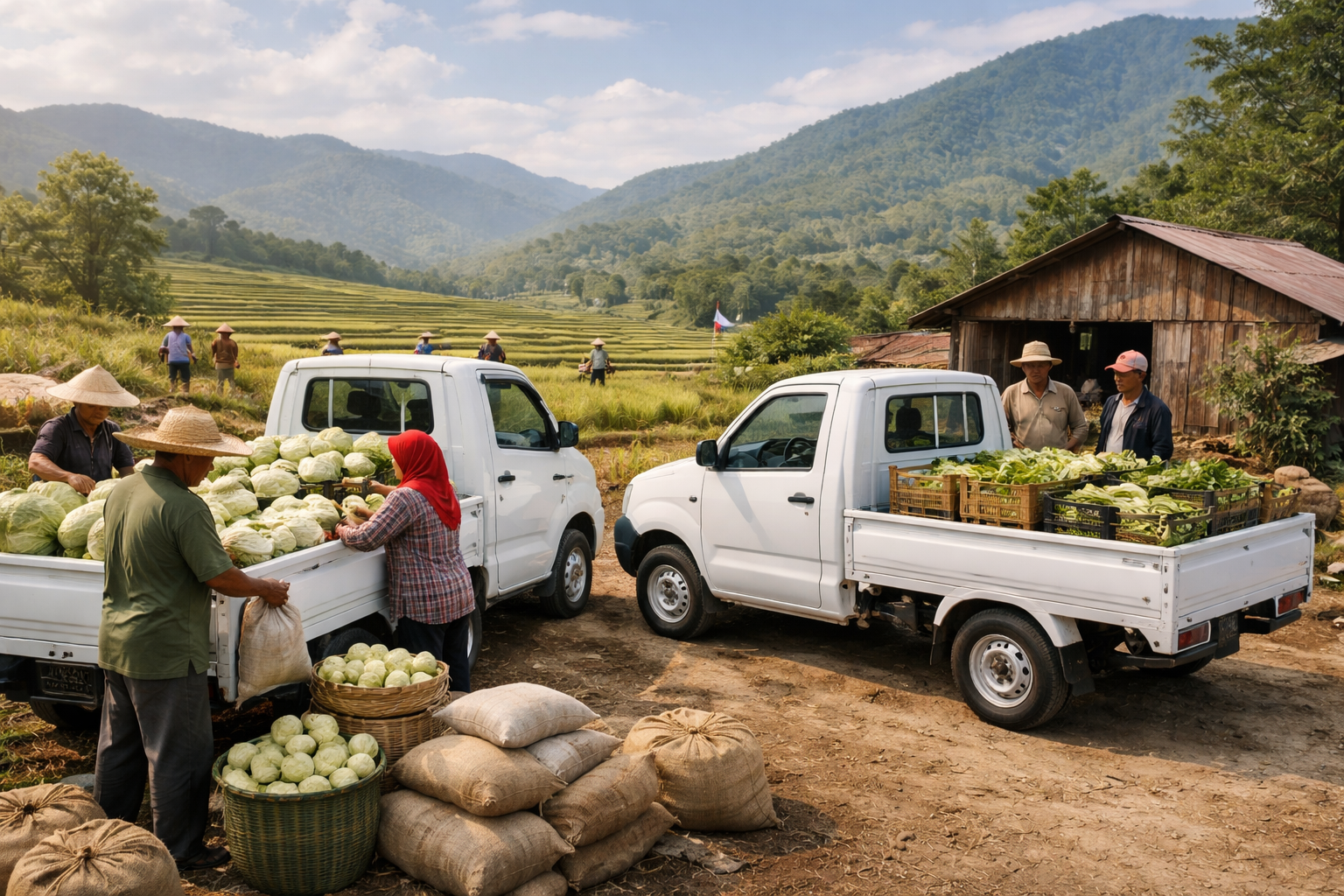
An important but often overlooked factor behind the procurement relates to the operational needs of the Koperasi Merah Putih (KMP) program, which aims to strengthen village-level cooperatives and improve rural distribution networks across Indonesia. The program requires thousands of vehicles to be deployed rapidly across villages to transport agricultural produce, fertilizers, and essential goods. Domestic manufacturers were not able to supply the required volumes within the tight timelines needed for the rollout of the KMP initiative. Importing vehicles therefore became a pragmatic solution to ensure that the program can be implemented efficiently and without delay.
Beyond the operational needs of KMP, the debate should also be viewed within the broader context of Indonesia–India economic relations. Bilateral trade between the two countries has grown rapidly in recent years and now exceeds approximately US$30 billion annually. However, the structure of this trade remains heavily skewed toward raw commodities. Indonesia’s exports to India are dominated by coal and palm oil, while India exports manufactured goods, pharmaceuticals, and technology services.
A sustainable long-term partnership requires diversification beyond commodities. It is neither realistic nor desirable for India to simply continue importing more coal and palm oil from Indonesia. Expanding trade into sectors such as automotive manufacturing, digital technologies, industrial equipment, and pharmaceuticals would create a more balanced economic relationship.
India’s role in the pharmaceutical sector offers a useful example. Indian pharmaceutical companies such as Sun Pharma, Dr. Reddy’s Laboratories, Cipla, Lupin, Hetero and Aurobindo Pharma are among the world’s largest producers of high-quality generic medicines. These companies supply affordable treatments for common conditions such as diabetes, hypertension, and infections. Generic versions of medicines like metformin, atorvastatin, and amlodipine have significantly lowered healthcare costs in many developing countries.
Globally, Indian companies produce nearly 20 percent of all generic medicines and supply around 60 percent of the world’s vaccines. Their presence introduces competition into pharmaceutical markets, helping ensure that essential medicines remain accessible and affordable. Similar benefits could arise in other sectors when competition is expanded.
Indonesia and India are natural strategic partners. Both are large democracies and major emerging economies in the Indo-Pacific. India has demonstrated an ability to democratize access to technology, from affordable pharmaceuticals to large-scale digital public infrastructure systems.
The same philosophy is visible in India’s automotive engineering approach. By prioritizing affordability and functionality, Indian manufacturers have made transportation accessible to small entrepreneurs, farmers, and logistics operators across developing economies.
For Indonesia, cooperation with India in sectors such as automotive manufacturing could help strengthen rural supply chains, support microenterprises, and expand access to affordable technology.
Rather than framing the debate as imports versus domestic industry, policymakers should focus on building a diversified and competitive automotive ecosystem. Imports can address immediate needs for national programs such as KMP, while longer-term policies could encourage Indian manufacturers to establish local assembly operations and partnerships with Indonesian companies.
Such an approach would combine the cost advantages of Indian engineering with domestic job creation and supplier development. More importantly, it would reduce dependence on any single industrial ecosystem and encourage a healthier competitive environment.
Indonesia’s development strategy should ultimately prioritize affordability, innovation, and broad access to technology. Opening the market to new partners is not a threat to national industry—it is an opportunity to strengthen it.