Accelerating the transition towards a low-carbon economy requires Indonesia to strike a balance between decarbonisation, economic growth, energy security, and national competitiveness. Amid growing energy demand from the industrial, transportation, infrastructure, and digital economy sectors, the energy system of the future needs to be cleaner while remaining reliable, affordable, and supported by domestic resources.
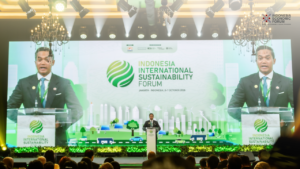
The issue was the focus of the panel “Powering Growth: Energy Security in the Low-Carbon Era” at the Indonesia International Sustainability Forum (ISF) 2026, held in Jakarta on Tuesday (6 October). The discussion explored how energy security can become part of an economic growth strategy through the development of renewable energy, the strengthening of energy infrastructure, transition financing, and the optimisation of domestic resources to reduce dependence on imports.
The panel featured Helen Clarkson OBE, CEO of The Climate Group; Justin Ma, Regional Head, Transition Finance and Advisory, Standard Chartered; Ashish Sharma, Executive Director, Group Sustainability, DBS Bank; Bobby Gafur Umar, President Director, PT Maharaksa Biru Energi Tbk; and Agung Wicaksono, Director of Transformation & Business Sustainability, PT Pertamina (Persero). The discussion was moderated by Antonio Castellano, Partner, McKinsey & Company, Singapore.
Learning and Adapting from Energy Shocks
The discussion opened with lessons from countries that have faced energy shocks. Helen Clarkson noted that countries that embarked on the energy transition earlier tend to have stronger adaptive capacity. She cited the surge in solar power use in Pakistan, which, according to her, is estimated to have helped the country save around US$12 billion through reduced crude oil imports.
Clarkson also highlighted that energy security is increasingly being viewed as part of national security. In this context, the development of clean energy is not only about reducing emissions, but also about a country’s ability to reduce its vulnerability to fluctuations in energy supply and prices.
Building a Reliable Energy System
From a financing perspective, Ashish Sharma emphasised that energy investment needs to cover the entire system, not just power generation. In addition to renewable energy, energy storage, transmission networks, and interconnections are important components for improving supply reliability. Sharma also highlighted the potential of solar panels and energy storage in Indonesia, including to reduce the use of diesel.
“We are not only funding individual aspects, but also the entire system and making it more reliable and self-sufficient in the future,” said Sharma.
Energy security is also closely linked to the ability to mobilise investment to support sustainable growth across various sectors.
Optimising Domestic Energy Potential
Bobby Gafur Umar highlighted Indonesia’s significant renewable energy potential, which is estimated at 3,687 GW, with more than 90 percent coming from solar power. However, the development of this potential still needs to be accelerated. According to him, large-scale energy development targets need to be supported by a diverse range of energy sources, industrialisation, and increased domestic manufacturing capacity.
“The key to achieving this is that we will not rely on only one energy source, because Indonesia is very rich in renewable energy resources. Therefore, industrialisation and manufacturing capacity must also play a role in this programme,” said Bobby.
Bobby also highlighted the importance of designing energy transition programmes that are attractive to investors while maintaining affordability for the public. He cited the cooperation between PLN and Danantara through the Giga One programme as one of the efforts to support the acceleration of the transition and strengthen Indonesia’s competitiveness in the region.
Balancing Current Needs and Decarbonisation
From a corporate perspective, Agung Wicaksono explained Pertamina’s role in maintaining energy supply while supporting government programmes, including the development of solar energy and B50 biodiesel. He also highlighted the PLTS Pulau Sembur programme, which, according to him, has generated social and economic impacts for the local community, as well as Pertamina’s approach to balancing current energy needs with the long-term energy transition.
Agung stated that the implementation of B50 can help reduce diesel imports, ease the country’s financial burden, lower emissions, and create jobs. He also said that 95 percent of Pertamina’s gas stations in Indonesia now provide B50 fuel.
The discussion also highlighted the importance of considering the long-term risks of every energy investment. Clarkson cautioned that decisions made today will shape energy assets and systems for the future. Therefore, transition fuels need to be assessed based on their role in meeting current needs without hindering long-term decarbonisation goals.
The panel discussion reaffirmed that energy security in the low-carbon era cannot be measured solely by the availability of supply. Resilience also depends on reliability, affordability, diversity of energy sources, adequate infrastructure, and the ability of the system to withstand shocks.
For Indonesia, the energy transition needs to be pursued as part of a growth strategy: strengthening domestic capacity, maintaining industrial competitiveness, reducing dependence on imports, and building the foundations for long-term energy security.