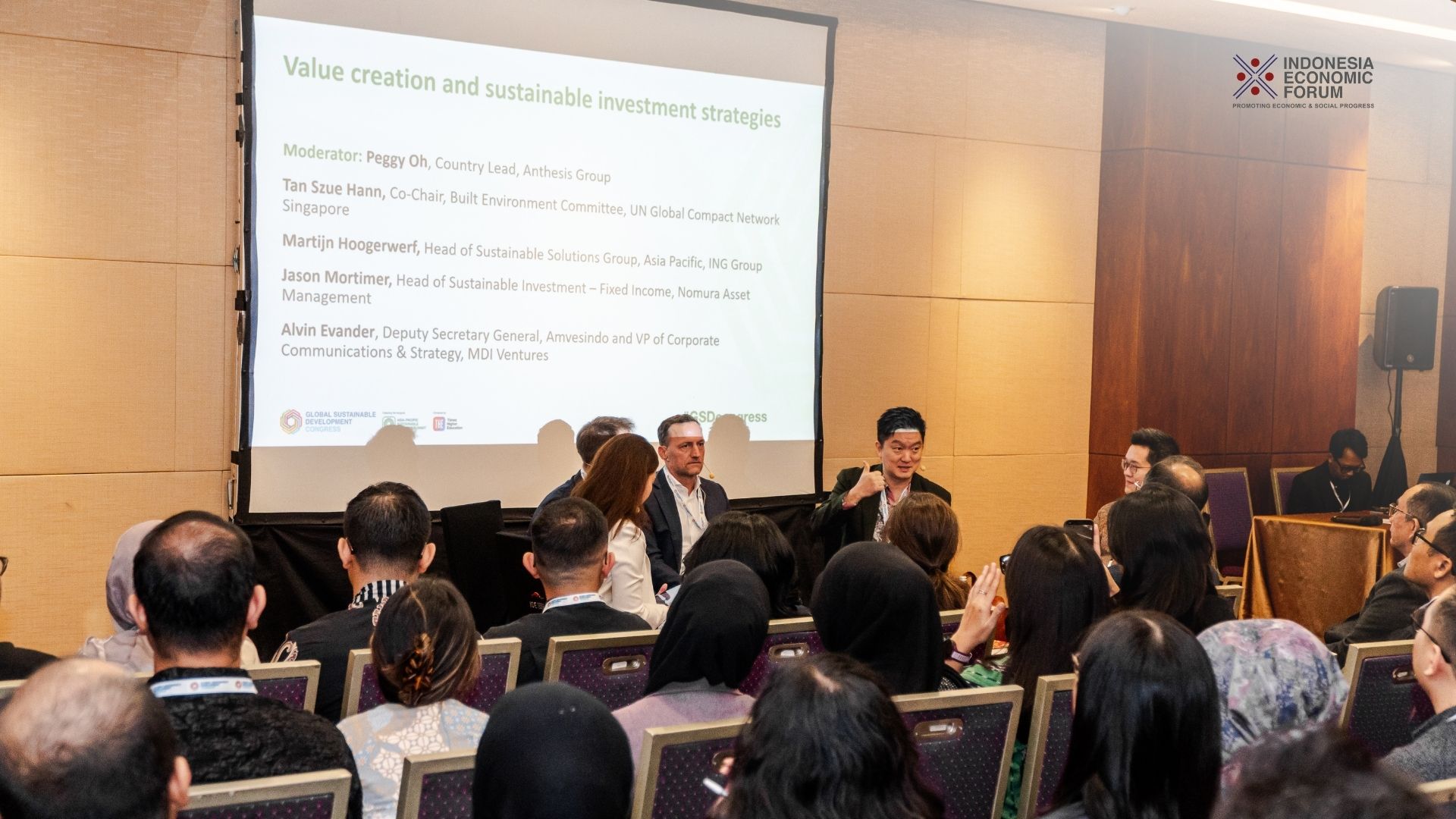
Jakarta — Sustainability is increasingly being recognized as a driver of long-term value creation rather than merely a compliance requirement, according to investors, bankers, venture capital leaders, and sustainability practitioners speaking at the Global Sustainable Development Congress (GSDC) 2026, held at the Indonesia Convention Exhibition (ICE), BSD City, Indonesia, on Monday (22/6/2026).
The discussion took place during the panel session “Value Creation and Sustainable Investment Strategies” moderated by Peggy Oh, Country Lead at Anthesis Group. Bringing together experts from asset management, banking, venture capital, and the built environment sector, the panel examined how sustainability is shaping investment decisions, strengthening corporate resilience, and supporting growth across the Asia-Pacific region.
While approaches differ between markets and industries, speakers agreed that sustainability is increasingly linked to financial performance, risk management, and long-term growth rather than being viewed solely through the lens of reporting requirements.
From Compliance to Competitive Advantage
Tan Szue Hann, Co-Head of the Built Environment Committee at UN Global Compact Network Singapore, said sustainability discussions have evolved significantly over the past decade.
“It’s not really from a position of compliance and some ways of FOMO (fear of missing out), if you’re missing out,” he said.
Instead, companies are increasingly recognizing that sustainability measures can directly improve financial returns.
Drawing from his experience in real estate investment, Tan explained that retrofitting buildings to improve energy efficiency often leads to higher net operating income, stronger asset performance, and improved investment returns.
“We see an improvement in the net operating income, and that’s a direct indication on the bottom line,” he said.
He added that sustainability solutions are also becoming more operational expenditure-based rather than requiring heavy upfront capital investments, making them easier for companies to adopt while still generating measurable business benefits.
Investors Focus on Risk, Resilience, and Transition
For institutional investors, sustainability is becoming a critical tool for understanding risk and identifying long-term opportunities.
Jason Mortimer, Head of Sustainable Investment for Fixed Income at Nomura Asset Management, said sustainable investing has matured from being viewed primarily as a disclosure requirement to becoming an important part of investment analysis.
“As a fixed income investor, we’re very focused on downside risk avoidance,” Mortimer said.
“Any little bit of additional information we can get from ESG disclosure, from this non-financial data, that actually helps us avoid downside risk.”
Mortimer noted that investors increasingly want to understand how companies are managing their transition rather than simply categorizing them as “green” or “brown.”
“We’re starting to see much more convergence here, where it’s not just about whether you’re green or brown, but rather how are you transitioning,” he said. “How can we accelerate that change rather than just sorting companies into the good guys and the bad guys?”
According to Mortimer, sustainability-related disclosures provide valuable insights that can help investors identify potential risks before they materialize.
His team has developed quantitative models that integrate sustainability data into credit analysis and investment decisions.
“We’ve been able to avoid some big headline bankruptcies and ESG crises because we have this downside risk-focused model,” he said.
Sustainable Finance Strengthens Corporate Governance
From the banking perspective, sustainable finance instruments are increasingly helping companies strengthen governance structures and improve accountability.
Martijn Hoogerwerf, Head of the Sustainable Solutions Group for Asia-Pacific at ING, said the market has evolved rapidly over the past several years, particularly in terms of sustainability disclosures, data availability, and corporate governance practices.
“When we structure sustainability-linked loans for our clients, we set sustainability KPIs and tie funding conditions to achieving those targets,” he explained.
This process often elevates sustainability discussions to the highest levels of corporate decision-making.
“One of the big benefits I’ve seen is the improvement of governance within our corporate clients,” Hoogerwerf said.
“It moves the sustainability debate into the CFO’s domain.”
ING now assesses sustainability performance through multiple lenses, including financed emissions, sector-specific decarbonization pathways, transition planning, sustainable finance targets, and climate-related risks.
The approach reflects a broader shift in the financial sector toward embedding sustainability considerations directly into core business processes rather than treating them as standalone initiatives.
“It’s not embedded in the marketing process anymore,” he said. “It’s embedded in the credit approval process.”
Startups Face New Expectations
The sustainability conversation is also reaching Asia’s startup ecosystem, although priorities vary depending on a company’s stage of development.
Alvin Evanders, Vice-President of Corporate Communications and Strategy at MDI Ventures, said Indonesia’s technology sector has experienced a dramatic slowdown in funding compared with the peak years of the venture capital boom.
As a result, many startups are now focused on profitability and cash preservation.
However, Evanders argued that sustainability remains increasingly relevant for young companies.
“We always tell our companies to focus on two things,” he said. “One, to manage their risk better, and two, to create value.”
According to Evanders, sustainability strategies can help startups attract customers, improve governance, and unlock access to impact-focused investors.
MDI Ventures has also worked directly with portfolio companies to establish sustainability reporting frameworks and governance structures.
“Last year we helped eight of our companies create their first sustainability report,” he said.
Building an Ecosystem for Sustainable Finance
Panelists also discussed the growing role of sustainable finance instruments such as green bonds, sustainability-linked loans, and transition finance.
While these tools continue to evolve, speakers agreed they can provide tangible benefits when paired with robust measurement systems and clear performance targets.
Mortimer noted that sustainable bond issuers often gain access to a broader and more stable investor base.
“Green bonds actually outperformed, especially during times of market stress,” he said.
“Those investors tend to be stickier.”
At the same time, speakers emphasized that sustainable finance cannot succeed in isolation.
Banks, investors, corporates, regulators, insurers, and supply chains all have a role to play in supporting the transition.
Audience discussions also highlighted the importance of education and engagement, particularly for companies at the early stages of their sustainability journey.
“We want to get to yes,” Mortimer said. “Not just saying no if you’re not perfect, but helping you get better.”
Sustainability Must Reflect Local Realities
As sustainability frameworks continue to mature, panelists stressed that implementation must account for regional differences and varying levels of economic development.
Hoogerwerf noted that companies across Asia-Pacific are progressing along different transition pathways and require tailored approaches rather than one-size-fits-all solutions.
“You’ve got to understand the local environment as well,” he said.
The discussion concluded with a shared view that sustainability is becoming increasingly integrated into the way capital is allocated, businesses are managed, and risks are assessed throughout Asia-Pacific.
Rather than being a separate agenda, sustainability is now emerging as a core component of long-term value creation for both investors and companies navigating an increasingly complex economic and environmental landscape.