
by Shinta W. Kamdani – Chairperson of Asosiasi Pengusaha Indonesia (APINDO)
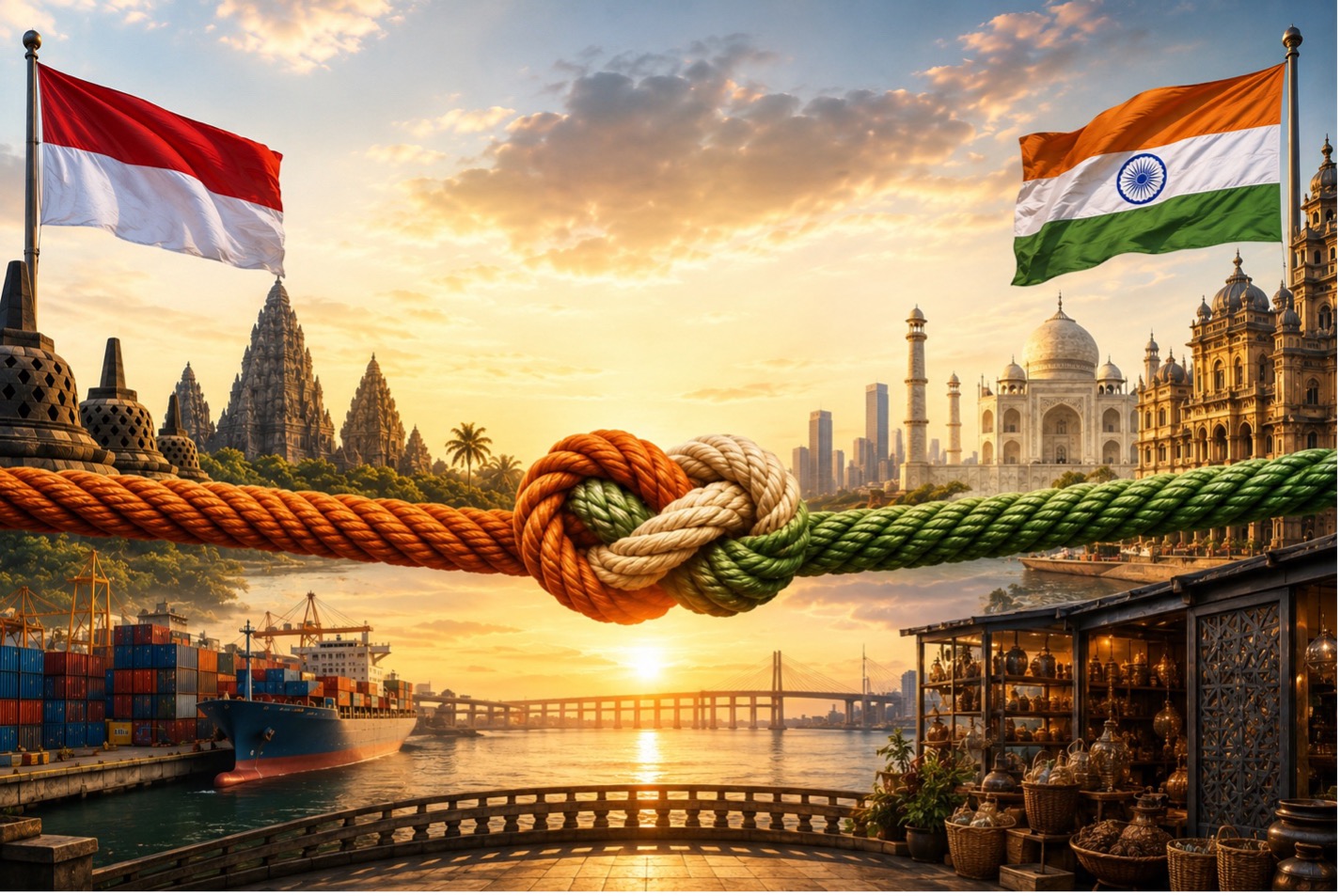
Long before supply chains connected our factories and investment linked our economies, the Indian Ocean carried something far more enduring between Indonesia and India, trust. Merchant vessels crossed its monsoon winds with spices, textiles, and stories, but they also transported an idea that has quietly survived the passing of centuries, that prosperity grows strongest when it is shared across borders rather than confined within them.
Merchant vessels crossed its monsoon winds with spices, textiles, and stories, but they also transported an idea that has quietly survived the passing of centuries—that prosperity grows strongest when it is shared across borders rather than confined within them.
That spirit found political expression when India became among the first nations to recognize Indonesia’s independence, lending its voice to a young republic seeking its rightful place in the international community. History remembers that gesture as diplomacy. Business remembers it differently, as an early investment in confidence, the one asset every enduring economic partnership ultimately depends upon.
Prime Minister Narendra Modi’s state visit to Indonesia, following President Prabowo Subianto’s landmark visit to India earlier this year, offers an opportunity to renew that confidence for a different era. Trade, investment, and capital will always matter. Yet the strongest economic partnerships are rarely built by transactions alone. They are sustained by shared rules, trusted infrastructure, and ecosystems that allow businesses of every size—not only the largest corporations—to innovate, compete, and grow together.
That, in my view, should become the defining ambition of Indonesia–India relations.
A Bigger Story Than the Numbers Tell
If markets are the clearest expression of confidence, then Indonesia and India already have a compelling story to tell.
India has grown into Indonesia’s third-largest export destination. In 2025 alone, Indonesian exports to India reached US$18.3 billion, while imports from India totaled US$4.7 billion, placing India among Indonesia’s ten largest sources of imports. Our commercial relationship continues to deepen, underpinned by increasingly complementary economic structures and further facilitated by the ASEAN–India Free Trade Area, which has been in force since 2010.
Yet perhaps the most telling figure is that, in 2025, Indonesia–India trade still accounted for less than 5% of Indonesia’s total global trade. Far from suggesting a lack of dynamism, the figure points to how much room remains for deeper economic integration.
Our economies have become increasingly complementary. Indonesia continues to supply India with resources that power industrial expansion, from mineral fuels and vegetable oils to iron and steel, inorganic chemicals, and industrial raw materials. India, meanwhile, contributes machinery, automotive components, electrical equipment, organic chemicals, and manufacturing technologies that reinforce Indonesia’s own industrial transformation. The relationship is increasingly complementary, creating value across both production and supply chains.
The same pattern is visible in investment. Indian foreign direct investment (FDI) into Indonesia reached approximately US$3.8 billion in 2025, expanding by more than 358% over the past five years. Indian enterprises have established a growing presence across mining, critical minerals, energy generation, metals, automotive manufacturing, engineering, chemicals, financial services, and consumer goods.
The range of sectors involved suggests a relationship that is becoming broader, deeper, and increasingly anchored in long-term industrial collaboration.
Expanding trade remains important, but the greater imperative lies in building the architecture that enables trade, investment, innovation, and opportunity to multiply far beyond what today’s numbers suggest.
What If the Next Breakthrough Isn’t a Trade Deal?
During President Prabowo Subianto’s visit to New Delhi in January 2025, Indonesia and India signed a MoU on Cooperation in the Fields of Digital Development. The scope reached well beyond technology, encompassing Digital Public Infrastructure (DPI), digital business partnerships, cybersecurity, digital capacity building, and emerging technologies.
Behind the agreement was a simple but consequential idea: the next phase of economic cooperation will increasingly be shaped by the infrastructure that connects businesses, people, and markets in the digital age.
That idea is now taking shape through the Indonesia Open Network (ION). Drawing inspiration from India’s remarkable success with the Open Network for Digital Commerce (ONDC), ION is being developed as an open and interoperable Digital Public Infrastructure for digital commerce in Indonesia. Rather than creating another marketplace, it seeks to create a network where MSMEs, cooperatives, merchants, technology companies, financial institutions, logistics providers, and digital platforms can connect through shared standards instead of operating in isolated ecosystems.
The implications reach far beyond technology. For millions of Indonesian MSMEs, digital participation often depends on the boundaries of individual platforms. ION offers a different proposition: an open network where businesses retain greater choice over how they connect with customers, logistics providers, and financial services.
A coffee cooperative in Aceh, a fisheries enterprise in Maluku, or a furniture maker in Jepara should be able to participate in the digital economy without being confined to a single commercial ecosystem. That is the kind of inclusion Indonesia’s digital transformation should aspire to deliver.
This is precisely why APINDO chose to become part of the journey. A more competitive Indonesia cannot be built solely by helping large companies grow; it also depends on whether MSMEs can access the same digital opportunities that larger businesses already enjoy. That conviction has long shaped APINDO’s work through UMKM Merdeka, our flagship initiative to strengthen the capacity, competitiveness, and market access of Indonesian MSMEs.
ION extends that same commitment into the digital economy, creating an open network that enables more small businesses to participate, connect, and grow.
Since late 2025, APINDO has been working alongside the Ministry of MSMEs, the Ministry of Communication and Digital Affairs, and technology partners from Indonesia and India to help prepare ION for its launch. The initiative reflects what becomes possible when public policy, private-sector innovation, and cross-border collaboration move in the same direction.
Serving on ION’s Advisory Council has reinforced one conviction. The real value of ION does not lie in the technology itself. Its significance lies in what Indonesia and India are beginning to build together, adapting India’s experience in open digital networks into an Indonesian ecosystem that reflects our own priorities, institutions, and economic structure.
That, to me, is where the relationship between our two countries quietly enters a new chapter.
Beyond Bandhan
In Sanskrit, Bandhan speaks of a bond, one sustained by trust rather than convenience. It is an apt reflection of Indonesia and India’s relationship, which has continued to evolve from diplomatic solidarity into economic partnership, and now toward shared innovation.
Every generation inherits a different responsibility. Ours is not simply to preserve a strong relationship, but to make it more relevant for the future. Trade will continue to grow. Investment will continue to matter. Yet the partnerships that endure are those that leave behind institutions capable of creating opportunity long after today’s transactions are complete.
That is why initiatives such as ION matter. They broaden participation, strengthen economic resilience, and place MSMEs closer to the center of digital growth. For APINDO, supporting this effort is consistent with a longstanding belief that Indonesia’s competitiveness will ultimately be measured by how many businesses—not just how many large corporations—can participate in national prosperity.
Prime Minister Modi’s visit comes at an important moment for both countries. The relationship has reached a point where its greatest opportunities may no longer lie in what Indonesia and India trade with each other, but in what they choose to build together.
More than seventy years ago, the Indian Ocean carried the solidarity that helped a young Indonesia find its place in the world. Today, it connects two economies ready to leave a different legacy.
About the Author

Shinta W. Kamdani is Chairperson of the Indonesian Employers Association (APINDO) and CEO of Sintesa Group. She is a leading voice on Indonesian business competitiveness, MSME development, sustainability and international economic cooperation.


