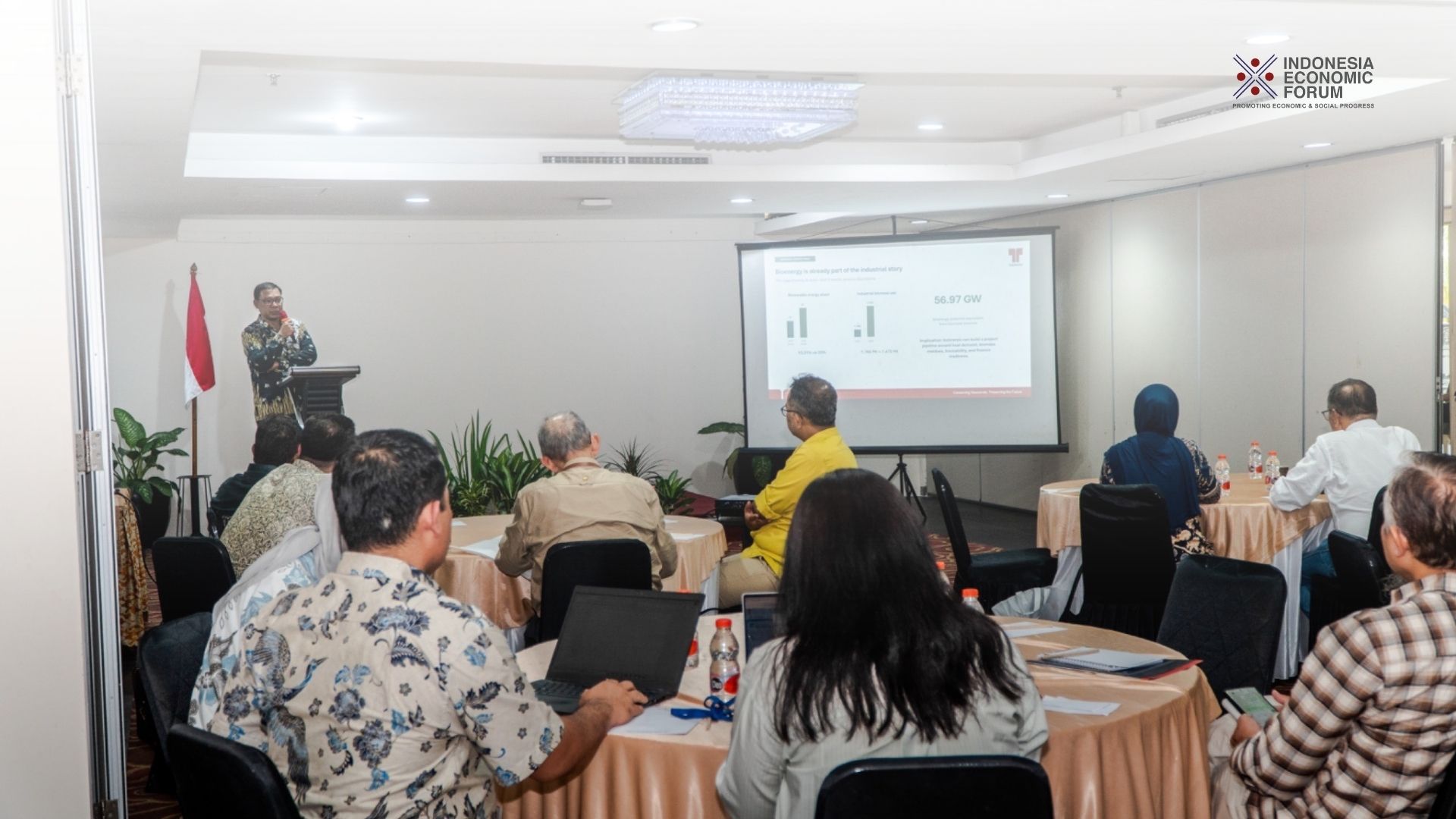
Karawang (Indonesia Economic Forum) — Indonesia Economic Forum, together with Thermax and The Habibie Center, held the SETAP Seminar titled Rethinking Energy Transition for a Volatile World at Asialink Premier Karawang on Thursday (21/5), bringing together industrial stakeholders to discuss how biomass solutions and industrial heat technologies can help industries respond to rising fuel uncertainty, tightening environmental regulations, and growing sustainability demands.
The seminar formed part of the Sustainable Economic Transformation and Acceleration Program (SETAP), an initiative by The Habibie Center aimed at helping industries prepare for future sustainability regulations through capacity building, technology access, and financing facilitation.
The forum focused on practical approaches to energy transition in Indonesia’s industrial sector, particularly through biomass utilization, thermal efficiency improvements, emissions control systems, and alternative fuel strategies aimed at strengthening industrial resilience while maintaining competitiveness amid global energy volatility.
Opening the seminar, Apit Pria Nugraha, Associate Fellow at The Habibie Center, said the current global situation requires industries to rethink energy transition from a more practical and industrial perspective.
“We are not discussing energy transition in a calm world. The world today is volatile and unpredictable,” he said, pointing to growing geopolitical instability and uncertainty in fuel supply and pricing.
According to Apit, many discussions around decarbonization focus heavily on electricity, while industrial heat systems are often overlooked despite being fundamental to manufacturing operations.
“Electricity may be considered the brain of a modern factory, but heat is often the muscle,” he said. “Without reliable heat systems, production can stop.”
He explained that industrial processes rely heavily on steam, thermal oil, hot air systems, and boiler technologies, making thermal efficiency a crucial component of any realistic energy transition strategy.
Balancing Sustainability and Industrial Competitiveness
A recurring theme throughout the seminar was the challenge industries face in balancing environmental compliance with operational costs.
Apit acknowledged that while companies are increasingly pressured to reduce emissions and adopt renewable alternatives, transitioning away from conventional fuels remains economically difficult for many sectors.
“When industries are asked to lower emissions or improve energy efficiency, there is always a cost involved. And when costs increase, competitiveness can decline,” he said.
He noted that biomass adoption in Indonesia still faces logistical and economic barriers despite the country’s large supply potential.
“The critical point for biomass is logistics,” Apit explained. “Transporting biomass such as wood chips can be significantly more expensive compared to coal in terms of energy density.”
Still, he emphasized that biomass utilization in Indonesia is growing rapidly, particularly in sectors such as palm oil, sugar, food processing, and cement industries. He also stressed that future sustainability claims would increasingly depend on traceable and verifiable supply chains, especially for export-oriented industries facing global regulations such as the European Union’s Carbon Border Adjustment Mechanism (CBAM).
“Biomass does not automatically become sustainable simply because it is renewable,” he said. “The sourcing must also be legal, traceable, and recognized by global markets.”
Apit also introduced the broader goals of SETAP, which aims to help industries understand future environmental requirements while connecting them with technology providers, financing opportunities, and practical transition pathways.
“We want industries to be prepared, not overwhelmed, when new environmental regulations arrive,” he said.
Gas Price Volatility Pushes Industries to Reconsider Energy Strategy
During the seminar session, Sujit Vargis, Head of Sales & Marketing at Thermax International Indonesia, said industries in Indonesia are increasingly reassessing their energy strategies as gas availability tightens and fuel prices continue to fluctuate.
“We find that gas availability and fuel prices are really increasing in Indonesia, especially in West Java,” he said.
Sujit explained that Thermax has been developing integrated solutions spanning clean energy, clean air, and clean water technologies to support industrial sustainability initiatives.
“We are not tied to one particular technology,” he said. “The idea is to provide solutions that match the operational and environmental requirements of each industry.”
He added that the company’s portfolio includes biomass boilers, waste heat recovery systems, wastewater treatment, emission control technologies, hybrid cooling systems, and digital monitoring platforms aimed at improving industrial efficiency and reducing downtime.
Sujit also highlighted Thermax’s growing investment in emerging technologies such as bio-CNG, green hydrogen, carbon capture, and sustainable aviation fuel derived from biomass feedstocks.
Meanwhile, Samina Khalid, Head of Corporate Communications at Thermax Global, emphasized the importance of collaboration between industries, technology providers, and policymakers in accelerating practical energy transition efforts.
She noted that industrial sustainability can no longer be approached only from a climate narrative, but also from the perspective of resilience, operational continuity, and long-term competitiveness.
Biomass Seen as a Practical Industrial Alternative
The technical seminar session led by Arzan, Project Sales Manager at Thermax International Indonesia, alongside Panca Sembiring, Area Sales Manager at Thermax International Indonesia, focused on the operational realities of transitioning from gas-based systems to biomass-fired boilers.
Using comparisons between multiple fuel types including coal, gas, rice husk, palm kernel shell (PKS), wood chips, and wood pellets, the session highlighted how industries could significantly reduce operational costs through biomass utilization despite higher initial investment requirements.
“One thing is very clear. Sustainability is not free of cost,” Arzan said. “If you want to transition toward biomass boilers, there will be higher investment costs initially. But the payback can happen within one to one-and-a-half years because operational costs decrease drastically.”
According to the presentation, uncertainty surrounding gas prices has become one of the biggest concerns for industrial operators today.
“The biggest issue today is uncertainty in fuel prices and availability,” he explained. “Industries are struggling because gas prices continue to increase.”
Arzan also detailed how fuel characteristics directly affect boiler efficiency, operating costs, and fuel consumption. While gas-fired boilers generally operate at higher efficiency levels, biomass systems can provide stronger long-term cost stability because of lower fuel expenses.
The seminar additionally explored several combustion technologies suitable for industrial biomass applications, including fluidized bed combustors, reciprocating grate systems, and chain grate boilers.
Arzan noted that reciprocating grate technology offers significant flexibility for Indonesia’s biomass landscape.
“It can burn coal, rice husk, wood chips, palm kernel shell, empty fruit bunches, and other biomass fuels with high moisture content,” he said.
Complementing the discussion, Panca Sembiring highlighted the importance of condensate recovery systems in improving industrial energy efficiency. He explained that many factories still waste high-temperature condensate from production processes instead of recycling it back into the system.
“Every six-degree Celsius increase in feedwater temperature can generate around one percent energy savings,” Panca explained during the seminar.
He added that condensate recovery not only reduces fuel consumption, but also lowers water usage and chemical treatment costs, making it one of the most practical efficiency measures available for industrial facilities.
Preparing Industries for Stricter Emission Standards
Another major discussion point focused on industrial emissions and the need for cleaner combustion systems as environmental regulations tighten across Southeast Asia.
Sujit Vargis explained that Indonesia’s current emission standards are likely to become stricter over time, following regional trends in countries such as Malaysia.
“Emission requirements in Indonesia will become more and more stringent,” he said. “Industries need to start preparing now.”
According to Sujit, industries should not only focus on meeting minimum compliance thresholds, but also consider long-term operational efficiency and environmental performance when selecting air pollution control systems.
He noted that while scrubbers remain widely used in Indonesia, the technology can create additional environmental challenges if not properly managed.
“Scrubbers can shift air pollution into water pollution,” Sujit explained. “You may not see smoke anymore, but the pollutants are transferred into wastewater.”
During the seminar, Thermax compared several emission control technologies including electrostatic precipitators (ESP), bag filters, scrubbers, and cyclone systems. Sujit highlighted that ESP systems can significantly reduce particulate emissions while also lowering long-term operating costs.
He added that dry ash handling systems can create additional value for industries by allowing biomass ash to be reused for agricultural purposes such as fertilizer applications.
Throughout the seminar, speakers repeatedly emphasized that energy transition for industries must be approached not only as a sustainability agenda, but also as a matter of energy resilience, economic practicality, and long-term industrial competitiveness in an increasingly uncertain global environment.
Rather than presenting biomass and thermal technologies as purely environmental solutions, the seminar reflected a growing shift in industrial thinking: companies are increasingly seeking energy systems that can simultaneously reduce operational risks, stabilize fuel costs, improve efficiency, and support future compliance requirements.
The forum also highlighted how Indonesia’s industrial sector may soon face increasing pressure from stricter global supply chain standards, emissions regulations, and sustainability verification frameworks. In that context, technologies related to industrial heat, fuel flexibility, emissions control, and resource efficiency are expected to play a much larger role in shaping the country’s manufacturing competitiveness over the coming years.
Closing the seminar, Samina Khalid emphasized the importance of stronger collaboration between industries, technology providers, and policymakers to ensure that energy transition efforts remain practical, scalable, and economically sustainable.
For participants and organizers alike, the discussion in Karawang underscored that the question is no longer whether industries should transition toward cleaner energy systems, but how they can do so while maintaining resilience and competitiveness in a rapidly evolving global energy landscape.